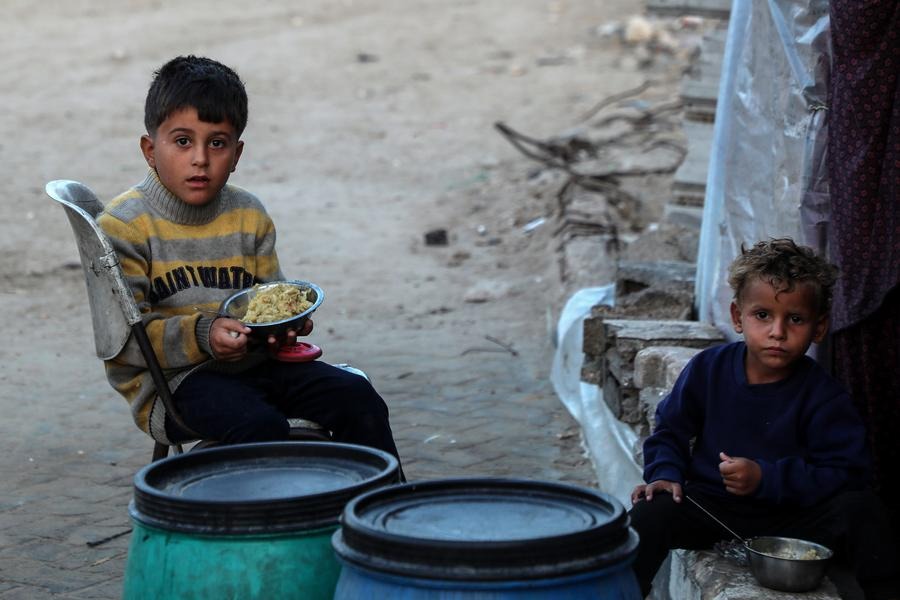
Gaza children face adult responsibilities as war leaves families without breadwinners









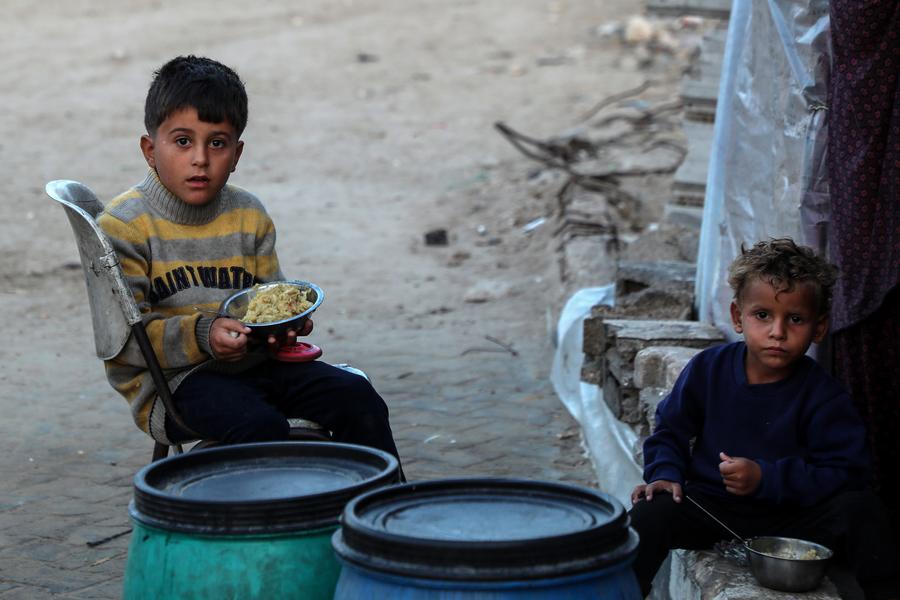
GAZA - With heavy steps, 11-year-old Mahmoud Abu Awda makes his way through puddles left by winter rains on a damaged street in Gaza City.
His worn-out shoes sink into the mud as he clutches a small plastic box of biscuits, canned goods, and chocolates, praying he can sell enough to keep his family going after they lost their breadwinner nearly two years into the Gaza conflict.
Before the war, Abu Awda lived an ordinary childhood. Every morning, he woke to the sound of his father preparing for work as a carpenter in the Zeitoun neighborhood.
"I used to go to school every day," Abu Awda told Xinhua. "I liked math, and during recess we played and laughed. Life was simple, but we were happy."
His "simple life" was completely upended when the large-scale Gaza conflict erupted on Oct 7, 2023, as the Israeli military launched a widespread operation across the entire enclave.
Since the outbreak, Gaza-based health authorities have confirmed that over 70,000 Palestinians, including at least 20,000 children, have been killed in the conflict.
Abu Awda's father was among the dead. He was killed in an Israeli airstrike that struck their home in Zeitoun. "My father was killed, and since then, I became the eldest and the only provider," Abu Awda said. "My mother is sick, and my brothers are still very young."
Unable to return to school, the boy bought a small box and began wandering through intersections to sell low-cost items. "Sometimes I sell, sometimes I don't," he said. "But there's no other option."
Abu Awda's story is just one of many.
In Khan Younis, in the southern Gaza Strip, 13-year-old Yasmin Khader climbs over piles of garbage next to the makeshift displacement camp where her family has lived since the conflict began. Along with other children, she gathers plastic scraps to sell.
"My father wanted me to become a doctor, but he was killed in an airstrike," Yasmin told Xinhua. "Now I work because there is no one else to support my mother and sister."
Each morning, she ties a white bag to her back and searches for plastic items to sell. "Sometimes the money is not even enough to buy bread," she said.
Yasmin remembers that before the war, she was "proud of wearing clean clothes and perfume," but the conflict has altered every aspect of her daily life.
"Children in this war, both boys and girls, have been burdened with responsibilities far beyond their age," she added. "We don't want this life, but we have no choice. We suffer every day just to survive, and no one is helping us overcome the consequences of this war."
In Gaza City's Rimal neighborhood, 13-year-old Abbas al-Ghazali has been selling water since dawn. Carrying a small box of bottles, he walks through the damaged streets, calling out, "Water for sale!" As winter sets in, his sales have dwindled sharply.
"I sell a bottle for one shekel, but people don't buy much now," he said. Al-Ghazali was pushed into work after his father, who suffers from cancer, could no longer receive treatment due to the Israeli blockade and the shortage of essential medicines.
While spending most of his day working, al-Ghazali still carries his schoolbag with a few books inside. "I used to be an excellent student," he said. "When I get tired, I open my bag and read a little."
Local authorities say the war has had severe consequences for children. According to the Hamas-run government media office, thousands of children lack safe shelter or an environment conducive to healthy development.
With education disrupted for over two years and thousands of schools either damaged or destroyed, child labor has surged in Gaza. Public spaces, such as markets and open streets, have become common workplaces for children who have been forced out of classrooms.
Ghadeer Al-Muqayyad, a psychologist specializing in child development in Gaza City, told Xinhua that the conflict has forced children into situations that exceed their emotional and physical capacities.
She explained that the rise in child labor exposes minors to dangerous conditions and threatens their long-term well-being. "These children are enduring trauma, loss, displacement, and exposure to violence, which can result in symptoms of post-traumatic stress."
According to Al-Muqayyad, prolonged stress increases the risk of anxiety, behavioral challenges, and emotional withdrawal among children.
"Reintegrating children into a safe learning environment is essential to reducing the psychological impact of the conflict," she said.