The Great Wall and its many unsung heroes
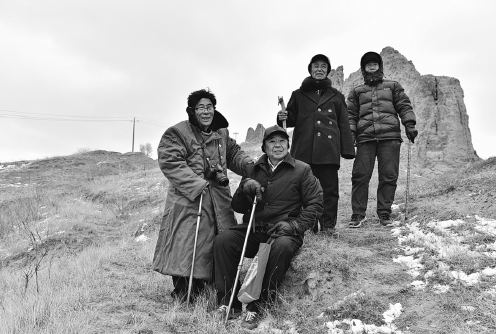
'Four old lunatics' have been protecting the root of a village's culture and history









Since a local feudal lord built a barbican on the approach to the then Great Wall in today's Yingxian county, Shanxi province, and named it Beiloukou in 344 BC during the Warring States Period (475 BC-221 BC), it has developed into one of the 200 major passes of the Great Wall.
But for most of the time over the past more than 2,000 years, Beiloukou served as a trade hub and a crossroad between Central China and Mongolia, Central Asia and Russia where people of different cultures met and intermingled. It gradually developed into a big town with hundreds of shops and more than 200 temples in its heyday.
But after sea transportation became the main means of China's foreign trade during the late Qing Dynasty (1644-1911), Beiloukou's fortunes, like those of the other land ports in North China along the Great Wall, started declining. Today, Beiloukou is like any other ordinary village in the region, except that the ruins of the Great Wall which is largely made of rammed earth, hay, bricks and sundry other building materials, and is more than 6 meters high and several meters wide with grass growing on its thatched top.
It was common practice among the local villagers to build their pigsties, sheep pens and hen coops with bricks from the Great Wall, because they are stronger than the modern ones.
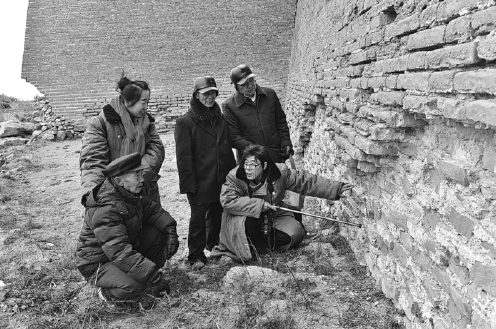
Although the Great Wall Protection Regulations came into effect in 2006, it was not until what locals call the "four old lunatics" started patrolling the Great Wall in Beiloukou in 2009 that local farmers stopped "stealing" bricks from the crumbling structure. Something they had taken for granted for generations, thinking the Great Wall, just like any mountain, was a valuable source of free quality bricks and good rammed earth, or a place where cave-dwellers dug small holes which served as temporary sheds for shepherds.
The "four old lunatics" who started patrolling along the Great Wall in 2009 are Li Shisheng, 86, Liu Shenglong, 79, Nie Tianfu, 77, and Chang Liang, 72. Li used to be a reporter for a newspaper, Liu is a doctor, Nie an accountant, and Chang was a township civil servant before retirement. All of them were born in Yingxian and are obsessed with the history of Beiloukou.
They volunteered to patrol the Great Wall because of their interest in local history, commitment to their hometown and their shared concern about the poor protection of the Great Wall. In short, they wanted to "do something" that would make the rest of their life more meaningful.
Talking about their age, Nie jokingly said: "Since the youngest villagers in Beiloukou are more than 50 years old, as all young farmers have left the village to work as migrant workers in cities, we are the middle-aged residents here."
At first people in the village did not understand their motive and referred to them as "lunatics", as they ran up the mountains and roamed along the Great Wall "for nothing". But the four used to smile back and just tell the villagers to take good care of the Great Wall, because "it is the root of Beiloukou's culture and history".
As time went by, their efforts began yielding results. The farmers gradually realized that if they continued to "steal" bricks and rammed earth from the Great Wall, it would eventually disappear one day. More important, thanks to their efforts, the village farmers started talking with them to know more about the history of their village and its connection with the Great Wall.
Nie said: "Our energy is limited, but people's power is limitless. Our purpose is to make the whole village as obsessed about history as we are. We want our children and grandchildren to understand the history of this village and pass it on to future generations."
Chang likes watching historical documentaries on TV and reading history books. He said that he has to recharge his batteries with knowledge, stressing that history is like a book that no one can finish reading as "the more one knows, the more he will realize he doesn't know anything".
Apart from water, simple food, mainly steamed buns, a compass, a pair of binoculars and torches, they also take their medicines with them, because all of them have underlying medical conditions. The medicines include isosorbide dinitrate-like pills which are used to treat heart failure due to systolic dysfunction, esophagus spasms, as well as to treat and prevent chest pain because of lack of flow of blood to the heart.
Once Nie fainted due to low blood pressure during patrol with the other three deep in the mountains. When he regained consciousness after a long time, he said, "I felt reassured … seeing the three old men beside me at the foot of the Great Wall." He added: "But I was also scared as I passed out, because I still had too much work left to finish my 'research' on the Great Wall."
Nie did not tell his wife about the incident, because he fears that after hearing it, she will not allow him to patrol the Great Wall again.
Li and Liu attach great importance to persuading the farmers to protect the old buildings in the village. They complained about the lack of historical records about the buildings. "It's a pity the village has few records of its own long history," Li said.
Still, thanks to their efforts, the village was recognized as a national-level ancient village in 2018. Which means more government funds will be made available for the protection and upkeep of the village's buildings and local intangible cultural heritages.
And due to the inflow of tourists, more and more villagers have come to value the history and culture of the village and the importance of the Great Wall.
Zhi Man'gang, a civil servant of the county's cultural relics bureau, said that the four men have made great contributions to the protection of the Great Wall in and around Beiloukou and the development of the village. "Within a decade, they have changed all the villagers' attitude toward the Great Wall and their own history."
"It is because of the unflinching efforts of these mostly unknown people that the Great Wall and other cultural relics in the county have been preserved for thousands of years," Zhi added. "They are the unsung heroes."





Today's Top News
- China to beef up personal data protection in internet applications
- Beijing and Dar es Salaam to revitalize Tanzania-Zambia Railway
- 'Kill Line' the hidden rule of American governance
- Warming of oceans still sets records
- PBOC vows readiness on policy tools
- Investment boosts water management