'Fish dads' help repopulate Yangtze River
Technicians try to prevent species from going extinct through artificial breeding









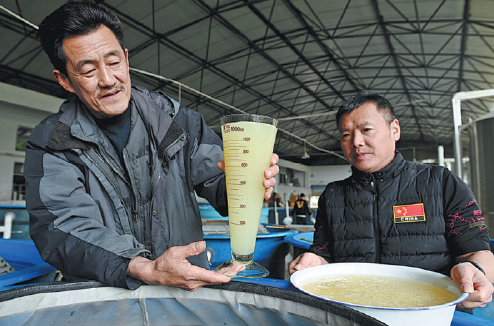
A group of male technicians, nicknamed "fish dads", from Chongqing's Wanzhou Fisheries Research Institute have made indispensable contributions to replenishing the biodiversity of the Yangtze River by breeding rare fish-about 70 million rare fish including Yangtze sturgeon and Chinese suckers that they've bred and released into the Three Gorges Reservoir area in the past decade.
In the breeding workshop for rare fish at the Shuanghekou base in Chongqing's Wanzhou district, one of the four breeding bases at the institute, 10 technicians are carefully inspecting the parent fish. Their main job is to help induce ovulation and then complete artificial insemination of various rare fish including Chinese suckers, Yangtze sturgeon, Yanyuan carp, Onychostoma angustistomata and Percocypris pingi.
Shuanghekou, located on a tributary 3 kilometers from the Yangtze, has abundant good water sources and flat terrain, which are ideal for breeding the rare fish. Local species from the Yangtze have high requirements for the environment, according to the institute.
"Our work is physically exhausting," said 39-year-old "fish dad" Wang Fei, who has been working at the institute for 16 years, mostly in Shuanghekou. He said the technicians deal with fish that can grow up to 30 kilograms, and they often have to work night shifts in the wild. "So gradually our team became all males and we are now called 'fish dads'."
The group of 23, who mostly majored in aquaculture, range in ages from 37 to 58.
"It's technical work that requires a lot of experience as well," said Wang.
He cited the Yangtze sturgeon, which is an ancient species but for which the sexual development of the male and female fish is not synchronized. So they have to judge whether the fish is mature enough for captive breeding by observing their growth cycle. Then they choose mature male fish and start the breeding.
He said the biggest technical difficulty lies in inducing ovulation. They once failed nearly 40 times before successfully figuring out how many injections of oxytocic were needed to collect the female Chinese sucker's eggs.
"It takes about five years for normal fish to sexually mature, while the spans for Chinese suckers and Yangtze sturgeons are 10 years and eight years respectively," said Wang, adding that the breeding window is short-the Spinibarbus sinensis has the shortest breeding window at a mere 10 days.
"Any mistake can largely bring down the quantity of fish fry the next year."
As early as 1976, the institute took the lead in captive breeding of the Chinese sucker, which has been under second-class State protection in China since 1989, according to the director of the institute Liu Benxiang.
In 1988, Liu graduated from the Aquaculture Department at Guangdong Ocean University. Located in Zhanjiang, Guangdong province, the university is one of the country's top institutes for aquaculture. Soon, Liu found a job at the institute, which is located in the upper reaches of the Yangtze.
Since Liu was appointed as director of the institute in 2002, he started to improve the feed formula, breeding devices and techniques, and has achieved major technological breakthroughs in the breeding of the species-the institute became the country's earliest national original breeding base for Chinese suckers in 2005.
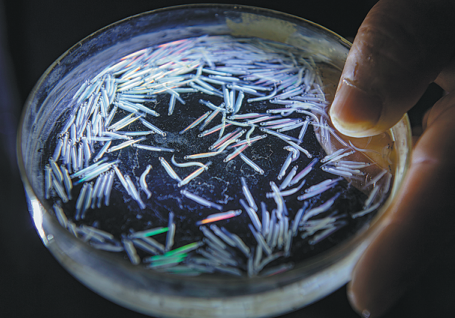
In April, the institute announced that it has incubated nearly 10 million baby Chinese suckers this year-nearly 4 million more than last year.
"The accumulated experience of breeding Chinese suckers can be applied in breeding other rare fish," said Wang.
After years of scientific research and practice carried out by Liu and the "fish dads", the institute has become one of the best breeding bases for rare fish in southwestern China-with an annual breeding capacity of around 50 million fish fry.
For now, the institute has reserved more than 3,000 parent fish including Yangtze sturgeon, which is under first-class State protection in China, and the Yanyuan carp, Onychostoma angustistomata and Percocypris pingi.
Stretching over 6,300 km, the Yangtze has rich biodiversity, but overfishing and pollution have threatened aquatic life and depleted fish stocks. Last year, China imposed a 10-year fishing ban to help reverse the trend.
To strengthen the ecological balance of the river in the past decade, Wanzhou has released more than 70 million rare fish into the reservoir area.
"Now home to 128 species, fishery resources in the Wanzhou section have been significantly restored. You can see the Yangtze taking on a beautiful and harmonious look, with real big fish in it," said Liu. "The water quality will be significantly improved within three to five years."
"It is hard to let ancient species adapt to the modern environment," Wang said regretfully after hearing that the International Union for Conservation of Nature and Natural Resources had announced the extinction of the Chinese paddlefish and the wild Yangtze sturgeon in its updated Red List of threatened species on July 21.
"But we will strive harder in protecting those that remain."




Today's Top News
- China to beef up personal data protection in internet applications
- Beijing and Dar es Salaam to revitalize Tanzania-Zambia Railway
- 'Kill Line' the hidden rule of American governance
- Warming of oceans still sets records
- PBOC vows readiness on policy tools
- Investment boosts water management