Elephant photographer reviews his career through long lens of memory
A renowned Chinese wildlife expert recalls his adventures and proposes measures to reduce conflict between the giant animals and humans. Yang Wanli and Li Yingqing report from Kunming.









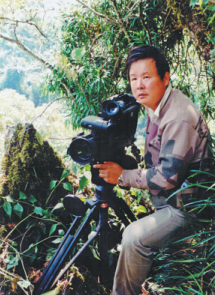
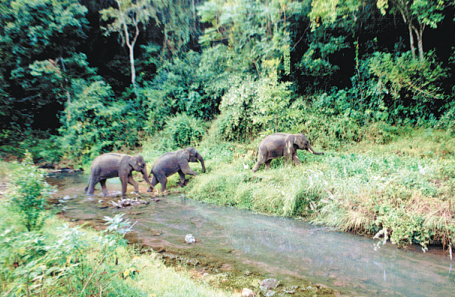
If there is a list of people who are best acquainted with wild Asian elephants in China, Zhou Xuesong's name is certain to be on it. From his mid-20s, he spent two decades chasing the animals in the rainforests of the southwestern province of Yunnan.
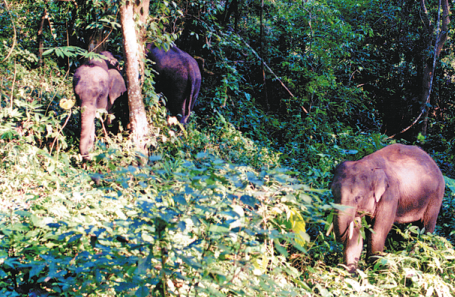
In 1991, Zhou started photographing and filming wild animals across the province, but Asian elephants, which in China are only found in Yunnan, were his major interest.
Recalling his career as a wildlife photographer, the 62-year-old said his love of nature started in primary school.
"In the 1960s, children were encouraged to go back to nature (as adults) and practice what they had learned at school. At the time, I dreamed of becoming a geologist," he said.
However, Zhou's career went in the opposite direction to his childhood ambitions. In 1985, he graduated from South China University of Technology in Guangzhou, capital of Guangdong province, with a degree in industrial automation.
Then, he began teaching the subject at Southwest Forestry University in Kunming, Yunnan's capital.
"Even though it hardly overlapped with the animals, it was my major that brought me to the turning point," he said, recalling how in 1991 he began working as a volunteer for a program supported by the university and the World Wide Fund for Nature.
"At the time, few people knew how to use cameras, so I was chosen as the program's photographer because of my professional background. That started my decadeslong relationship with animals, especially Asian elephants," he said.
Zhou said that in the 1990s China faced questions from people overseas about whether wild Asian elephants actually lived in the country, because there were no photos or videos of them. Between 1991 and 2012, he entered the virgin forests of southern Yunnan many times as he sought to put those doubts to bed.
Early Days
When he started, elephant conservation was still at an early stage. He recalled that forest rangers didn't even have two-way radios, let alone cameras, and the only vehicle on most farms was a motorized tricycle.
"While chasing after elephants, I fell into muddy puddles from my motorbike many times," Zhou recalled with a laugh.
As an experienced "elephant chaser" he said it's almost impossible for humans to keep up with the animals in the wild as they move faster than one would imagine.
"They run quickly (about 25 kilometers per hour). In the open, the nearest a human should get to one of these giants is about 200 meters," he noted.
Compared with pests such as mosquitoes and leeches that are "programmed" to attack their prey, he said many wild animals, including elephants, will not hurt humans unless provoked.
Recalling episodes of close contact with the animal, Zhou clearly remembers a terrifying meeting with a bull elephant in 1993.
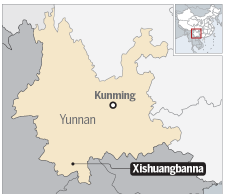
Just a few days after the Spring Festival holiday, Zhou entered a forest in the Mengyang Nature Conservation Area, a major elephant habitat in Yunnan's Xishuangbanna National Nature Reserve.
To locate a herd as quickly as possible, he had invited two brothers who lived in Mengyang to act as his guides. "It wasn't the first time we had worked together to record elephants. But the trip began badly. We chased a herd for three days but couldn't locate it," he said.
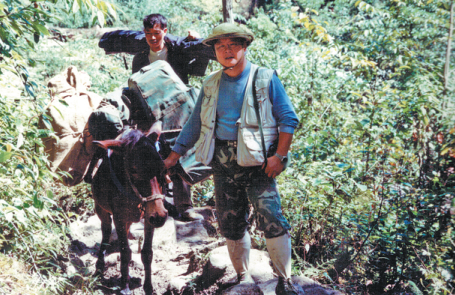
Zhou said the equipment used by wildlife photographers at the time was much heavier than modern appliances, while batteries only lasted about 30 minutes. In addition to all his gear and food, he carried a machete to cut a path through the ancient forest.
"All that gear weighed at least 30 kilograms. We were exhausted, so I decided to stay at a major pass on my own while the brothers continued to follow the elephants' tracks. They helped me build a viewing platform in the trees," he said.
Despite a long afternoon of waiting, Zhou saw neither the elephants nor the brothers, so he decided to return to the forest station before darkness fell. To that end, he set out walking through the forest carrying his bags.
"Suddenly, I heard a loud noise. It was the sound of bamboo cracking. I stopped and traced the source-it was a herd of 11 elephants, including a newborn calf, about 200 meters from me," he said. "Too excited to think clearly about the risks, I ran toward them," he recalled.
Suddenly, a bull elephant appeared in front of him. The distance between the two was only 30 meters. "I knelt down and turned my camera lens toward it, but within 10 seconds it had rushed up to me," he said.
At this life-or-death moment, he remembered some advice the brothers had given him, and quickly rolled down a hill. "They had told me that elephants slow down when they are going downhill to control their considerable weight," he said.
However, Zhou's descent was blocked by thick bushes, and the bull caught up with him in just a few seconds. "There were only about 10 centimeters between his trunk and my face. I could clearly feel his warm breath and sense my own fear. It was beyond anything I can put into words," he said.
It was a close call, but Zhou was saved by the brothers, who had noticed the herd as they returned.
The brothers beat bamboo sticks together and made a loud noise to draw the herd away from Zhou. His only injury was a gash on his leg caused by the fall, and the scar it left always reminds him of that meeting with the bull elephant.
New focus
Zhou's two-decade-plus pursuit of wild elephants affected his health. So, in 2013, in poor physical condition, he changed his focus to concentrate on butterfly protection.
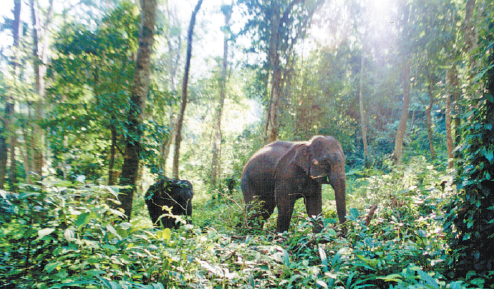
However, the news about the herd of elephants that left their habitat in Xishuangbanna and roamed around Yunnan rekindled memories of his days with the animals.
Recent reports suggest that the giant pachyderms are now heading back to their old stomping ground, but Zhou was not surprised that they had become mobile.
"In my opinion, migration is a common activity for wild animals, whose nature is to look for a comfortable place to stay and more food to feed their offspring. Their journey has made people think again about better ways of maintaining good relations between animals and humans," he said.
After tracking animals over many decades, Zhou believes that a balanced environment must involve moderate human activity.
"Sometimes, excessive forest protection can be bad for the animals. Thick cover limits the growth of the grasses and shrubs that feed herbivores, which in turn provide food for carnivores," he said.
He believes that wild elephants need homes with diverse plant life rather than tall trees.
"To solve such conflicts, I think a national park should be established to help formulate a long-term plan to restore the elephants' habitat and build harmonious relations between these old giants and humans," he said.
Shi Wenzhi contributed to this story.





Today's Top News
- Thailand and Cambodia agree to temporary ceasefire
- NPC's 4th annual session slated for early March
- Civilizational links for a fairer world
- Manufacturing in China spurs global growth
- Taiwan lawmakers vote to pass motion to impeach Lai
- Xi: Steadfastly implement conduct rules