|
|||
 |
|||
|
|||
|
|||
|
|||
|
|
||||||||||||||||||
Born on the Eighth of AugustBy Cui Xiaohuo (China Daily)Updated: 2007-06-22 10:40 To the frustration of his wife, Zhou Chenguang has spent thousands of dollars of his own money teaching Chinese children about the culture and sports surrounding the Olympics. Zhou, a physical education teacher in Beijing, said he is "addicted" to the Olympics and believes he was born to help advance the Olympic Movement. Coincidentally, he will be 39 on August 8, 2008, the opening day of the Beijing Games.
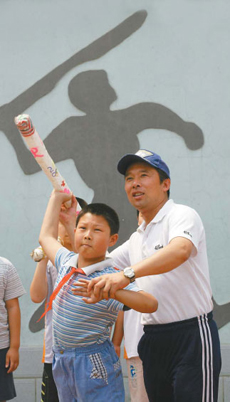
He has created over 1,000 games for his pet project and spent more than 100,000 yuan ($13,000) from his family savings to help introduce the Olympics to the school curriculum. Zhou co-created the 'mini-Olympics,' the first event of its kind in China, at Beijing's Yangfangdian Central Primary School, where he has been a PE teacher for almost 20 years. "My biggest wish is that my school becomes a living museum of Olympic education, with more and more children influenced by the power of sport," he said. The event was first held on May 10, 2002, less than a year after Beijing won its Olympic bid. In its inaugural year, all 850 students at the school competed in the 50m sprint, long jump, rubber discus, shot put and plastic javelin events, some of which were specially developed by Zhou. "I rolled up used pieces of foam from old cell phone boxes and wrapped them in plastic," he said, explaining how he came up with the child-friendly javelins. "I can throw it from here to the door," said Tian Jiageng, a chubby fifth grader, pointing to a door about 15m away. "Hoo, there it goes ..." he said, rushing off mid-sentence to join a group of friends playing cops and robbers. Although keeping them focused can be a challenge, Zhou said it was rewarding to see the children getting so involved in his Olympic-themed project. He said he designed everything from the javelins to the gold medals, which cost more than 100 yuan apiece and are stamped with the face of Zeus on the front and the name of the winner on the back. "We tied the medals with a traditional Chinese knot to display the combination of two beautiful cultures," said Zhou. Other decorations in the classroom are aimed at giving the kids a broader lesson in what can be achieved through sport. "This is a symbol of peace," said Lu Chen, pointing to a golden olive branch behind a window display. And that is one of the key messages of the Olympics, according to his teacher. "The Olympics should not just be about banners and slogans," said Zhou. "The Olympics is also about human passion, but at the same time it is rational and heart-warming." At times, Zhou's passion for the Games has exasperated his wife, Sun Jie, who had to watch their savings account drain away to fund Zhou's mission to reach out to his students. "It is impossible to stop him," she said, adding that it caused a few fights at home. "Anyway, we were both born in the year of the chicken, so we 'cockfight' a lot." Sun, a civil servant, said she felt demeaned at first when Zhou asked her to run errands for what she thought was just a flight of fancy. But his determination slowly won her over. The turning point came when their 9-year-old son was asked to preside over the torch-lighting ceremony to mark the school's establishment as an Olympic education model school in March 2006. "When he lit the torch, with that music playing in the background, I suddenly found tears streaming down my face," she said. "I was touched by the solemnity of the scene." A minute later, Zhou received a text message from his wife: "I was really moved. The things you have been doing these past years have been truly admirable." Pei Dongguang, co-creator of the 'mini-Olympics' and a good friend of Zhou's, said the event was also helping to challenge established stereotypes. "We used to stereotype every PE teacher as a sun-tanned man or woman with a whistle, a stopwatch and a measuring tape", he said. "People assumed sports were unskilled and had nothing to do with culture. However, we would like people to realize that sports, just like the Olympics, can be divine, solemn and romantic." Pei, a teacher at Beijing's Capital Institute of Physical Education, said it was time to light up the spirit of the Olympics in China. "This spirit is something that is still going unnoticed in China right now, and it therefore needs to be rediscovered through the Olympic Movement," he said. |
|