|
|||
 |
|||
|
|||
|
|||
|
|||
|
|
||||||||||||||||||
Green Olympics dream coming trueBy Xie Chuanjiao (China Daily)Updated: 2007-01-30 11:09 Beijing is on its way to realizing its dream of staging a "Green Olympics" by succeeding in disposing of 90 percent of its urban sewage in the proper manner before schedule.
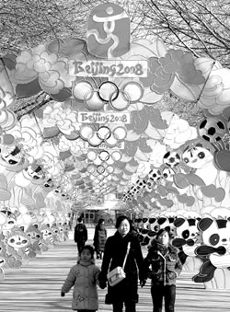
Tianjin residents walk in a park decorated with the 2008 Beijing Olympic Games mascots and motifs on Sunday. The decorations contribute to the celebratory atmosphere ahead of the lunar new year, which falls on February 18 this year. Li Shengli Beijing will increase its urban wastewater treatment rate to 92 or 93 percent this year by completing five more wastewater treatment plants in some urban as well as suburban areas, Jiao said. New technologies will be introduced to improve the quality of the disposed wastewater because the authority's goal is to increase the volume of recycled water being used to 480 million cubic meters, or one-tenth of the city's water supply. Also, the official said, more than 2.16 million rural residents, or 65 percent of the capital's total rural population, had access to safe drinking water by the end of 2006. "Another 300,000 rural residents will have access to safe drinking water within this year." And as part of the authority's "Green Games" efforts, Jiao promised to clean all the canals, moats and lakes within the Sixth Ring Road, too. "This year we will ensure that the clean ones stay clean and continue treating the rest, including the lower reaches of Qinghe River near the main venue." Beijing follows standard ecological norms while cleaning its rivers and lakes. "We don't change the natural course of rivers and ensure that their diverse plant and animal life is not disturbed," But despite all the authority's efforts Beijing still suffers from acute water shortage. "Among the methods we've adopted to solve the problem are strict water resources protection and management, search for new water sources, minimizing waste and a rationed supply policy." Eighty percent urban homes in Beijing have installed water-saving equipment; 332 water-saving technologies have been applied in industries; water-shaving cropland has increased to 20,000 hectares and 300 rainwater-recycling projects have been set up. All this, he said, shows "Beijing is doing remarkably well in reducing water consumption". By the time the Olympics open next year, Beijing would already have started getting 300 million cubic meters of water a year from four reservoirs in neighboring Hebei Province. And by 2010, the city would get another 1 billion cubic meters of water from the Yangtze River. |
|