Ancient music brought back to life
Updated: 2013-07-14 08:03
By Zhang Zixuan(China Daily)
|
|||||||


|
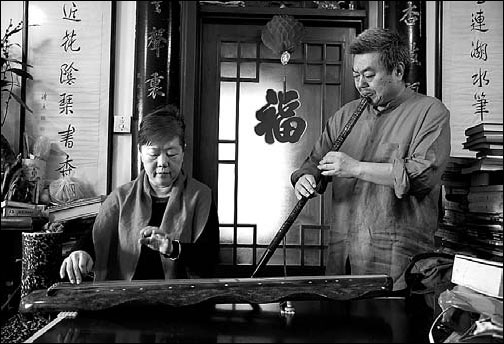
Gao Peifen, the fifth-generation inheritor of the Zhucheng guqin school, promotes the traditional Chinese art form, along with her husband, Zhang Fusen. Provided to China Daily |
On June 8, China's Eighth National Cultural Heritage Day, music many people thought had disappeared centuries ago was played in the Forbidden City.
The music was from a guqin, a seven-stringed plucked instrument with a history of some 4,000 years. The player was Gao Peifen, 59, the fifth-generation representative inheritor of the Zhucheng School - one of China's best-known guqin schools.
Gao and her disciples performed songs that the guqin master has painstakingly recovered from ancient scores that were almost lost forever.
Gao says the guqin's arched wood surface represents heaven, and its flat bottom represents earth. In Chinese measurement the standard length of a guqin is 3 chi, 6 cun and 5 fen (about 1.22 meters), representing the 365 days of a year.
The 13 dots on the surface, named hui, mark the positions of the 91 harmonics on the seven strings. They represent the 12 months of a year, plus a 13th month every two or three years as per the lunar calendar.
The most unique aspect, however, is its notation. Called Jianzipu, the notation solely designed for guqin is a combination of written Chinese characters and numbers, which indicate plucking techniques and finger positions.
The tablature, which can only be read by guqin players, was once described as "the book from heaven" in A Dream of Red Mansions, the classic Chinese novel from the Qing Dynasty (1644-1911).
The notation only indicates the notes, not the rhythm. To make the scores playable, therefore, there is a special procedure called "dapu", meaning to compose the rhythm of a guqin song.
"The procedure of dapu requires a guqin artist's profound knowledge of the instrument as well as years of study to the school characteristics," says 90-year-old Zheng Minzhong, scholar of the Palace Museum.
"There are notations of more than 3,000 songs passed down, but only around 100 songs have been given rhythm by older players," says guqin scholar Zhang Fusen, Gao's husband.
To recover those ancient songs, the couple traveled all over China collecting old guqin scores.
At an antique market in Tianjin, they found a book from the Ming Dynasty (1368-1644), which turned out to be the notation of the Shao, the legendary music born more than 5,000 years ago which was thought to be extinct.
Shao music was said to be so beautiful that it made Confucius (551-479 BC) "forget about the taste of meat for three months".
It has now came to life again under Gao's fingers after five years of hard work.
Since then, Gao has recovered more than 20 ancient songs that were on the edge of extinction.
"There are vivid landscapes of mountains, waters and people pictured in these songs that Gao has recovered and played, which contain a strong flavor of Zhucheng School and aesthetic value," says guqin scholar Tang Zhongliu.
In 2003, guqin music was described as one of the masterpieces of the Oral and Intangible Heritage of Humanity by UNESCO.
Gao's new monograph, which includes playable scores of more than 10 ancient songs that she has learned to play, will be published this autumn.
A teacher of more than 300 disciples, Gao is gratified that the ancient art continues to flourish in modern times. She has been training several candidates who have the potential to become the sixth-generation inheritors of the Zhucheng School.
"I hope the guqin art can live for another 4,000 years," says the guqin master.
zhangzixuan@chinadaily.com.cn
(China Daily 07/14/2013 page4)