Mapping global situation in the year 2030
Updated: 2007-12-28 08:04
The young global leaders of the World Economic Forum are publishing the "Future Mapping for the Global Agenda", a study which aims to plot key trends, risks, signals and their interrelation for a better understanding of how they will change the leadership environment in the coming decades.
It summarizes major tendencies and risks which will shape the world in 2030 and serves as a key tool to stimulate high-level discussions with leaders from business, media, politics and society about the future and the global, regional and industry agendas.
The concluding overview of "Future Mapping for the Global Agenda", entitled "Your Life in 2030", is striking in its appeal.
On the one hand, it is comforting to think that our lives in 2030 will indeed consist of "hi-tech and communicative" houses, food that is "convenient, delicious and healthy", and education for our children provided by "superstar teachers".
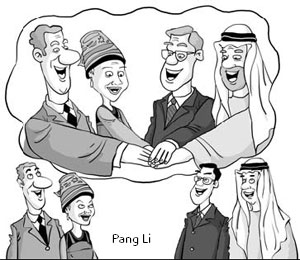
And yet, it is difficult to imagine that these predictions will accurately describe your life if you are among the 1.7 billion people expected to live in urban slums -- or if you are among the increasing number of refugees and internally displaced people that are expected to be created by a proliferation of intra-state conflicts.
The progression of human history with extreme discrepancies between the "haves" and the "have-nots" -- a phenomenon that is expected to decrease globally but increase within individual countries in coming decades -- is certainly not new.
And yet the global context is changing in important ways that make a world of "winners" and "losers" not only undesirable, but unsustainable.
For one, we have an increasing capacity to harm one another. "Future Mapping for the Global Agenda" notes the expected proliferation of weapons of mass destruction - including among non-state players.
Moreover, we are bombarded with information about the views and actions of others but often without the insight or understanding that would place those actions in context and recognize the human -- and therefore humanizing -- interests, values, hopes and fears that motivate them.
And if the prediction is correct that media is to become more personalized, it is easy to imagine many of us choosing that media which confirms our biases, reinforces our preconceived notions and echoes our sentiments on issues large and small.
Recent years have provided disturbing examples of where an interdependent world with plenty of information but little understanding can lead. Cartoons depicting a revered prophet in vile and despicable ways get printed in a relatively obscure newspaper and -- after months of poor decisions and inexcusable actions by media and political leaders alike -- spark violence and enduring polarization between religious and ethnic communities around the world.
Almost as if in response, a conference dedicated to calling into question one of the most horrifying events in recent history is held under a government's patronage, complete with a competition for the best cartoon lampooning the historical tragedy.
We have enough information to know how to toy with, ridicule and denigrate one another's most sensitive and revered symbols, but not enough empathy and compassion to understand why we should not.
"Future Mapping for the Global Agenda" is supposed to inform the community, ostensibly to help us better understand how we should lead the companies, communities, organizations and -- in some cases -- countries that we represent. In doing so, it offers windows into avenues we can pursue, which deserve to be highlighted.
While we look to governments to remove barriers to accessing information and to expanding and protecting freedom of the press, we should look to media leaders to use the tools at their disposal to enlighten as well as to entertain. If, as the document predicts, we are to witness a marked rise in "infotainment", how can we identify and communicate the facts and truths which may be difficult or even dissonant for some to hear, but which must be understood in order to ensure a real understanding of our world?
In noting an increase in religiosity, "Future Mapping for the Global Agenda" highlights its negative consequence -- growing radicalism. This may very well be the case, but a common error is made in the document by linking faith itself to radicalism -- particularly for Muslims -- when it highlights what it terms "radical Islam".
The most reliable studies and surveys prove again and again that there is no correlation between devoutness of practice and extremist views in Muslim societies. In fact, the common denominator of extremism is the perception of being under persecution, attack and persistent humiliation, whether due to political oppression and lack of opportunities at home or political domination and occupation from abroad.
More importantly, we should not ignore the fact that diverse religions and religious communities offer some of the very capacities and resources that will be most needed if we are to deal with the challenges that are expected to confront us in 2030.
For one, there is the capacity of religion to reach populations as no other force or institution can. Indeed, in this era of globalization it is easy to forget that nothing has achieved the truly global presence that our diverse religious traditions have -- synagogues, churches, mosques and temples remain by far the most ubiquitous institutions from the most remote villages to the densest urban neighborhoods.
And while religions are often blamed for many of the world's ills, there is at least as much evidence that they offer the deepest available reservoirs of empathy, compassion and humility, inspiring billions throughout history to act in service of others and even, at times, to forgive the unforgivable.
A world in 2030 that is marked by increasing intra-state conflict, expanding refugee and internally-displaced populations, and rapid urbanization - and its associated ills of family dislocation and increased crime and drug rates - will need the kind of service and leadership that religious leaders and communities are uniquely placed to provide. Their positive and constructive capacities should be recognized, welcomed and cultivated.
Shamil Idriss Young global leader of the World Economic Forum.Acting director, UN Alliance of Civilizations, United States
(China Daily 12/28/2007 page11)
|
|
|
||

|
|
|
|