Senior officials of ministries and agencies directly dealing with
intellectual property rights (IPR) were at a press conference yesterday to
address questions on China's IPR protection but Minister of Commerce Bo Xilai
ended up doing most of the answering.
Is China really getting tough with IPR offenders? Will China's campaign to
protect IPRs help narrow the trade surplus with the United States? Will the
crackdown on IPR infringements affect China's economy?
|
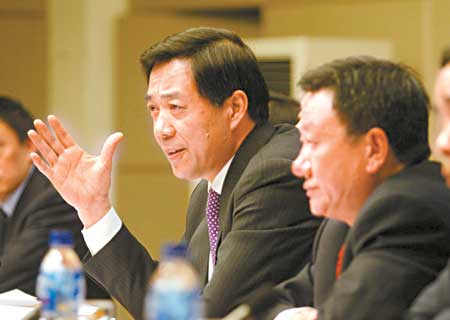
Minister of Commerce Bo Xilai
explains China's efforts to protect intellectual property rights (IPR)
during a news conference in Beijing yesterday. Bo rejected claims that IPR
problems are a major factor affecting the China-US trade balance. Sitting
beside him is Jiang Zengwei, director of State Office of Intellectual
Property Protection. [newsphoto]
|
|
|
|
A smiling Bo answered: China will go all out to bolster IPR protection, even
though it affects jobs.
"As far as I know, at least 300,000 law-enforcers and other people are
involved in IPR protection in China," he said, adding that between 2000 and
2005, 13,000 people were arrested for IPR violations.
In Beijing, for example, the local authorities have banned the sale of 48
famous brands at the Silk Street shopping mall a landmark known for inexpensive
branded goods to help stamp out counterfeit products.
Other cities like Shanghai and Guangzhou are also taking tough measures to
protect well-known brands, including closing down markets with poor records, he
said.
"The Chinese Government has been resolute in implementing all these measures
even though it has not been easy because they affect a host of jobs."
Bo said IPR protection has become a national policy of China.
"We understand how important IPR protection is to China's future
development," Bo said, adding the country's top leadership is committed to
building China into an "innovation nation" in 15 years, and IPR protection is
closely interwoven with the effort.
"IPR protection is something initiated by the Chinese Government itself for
the country's development, rather than because of outside pressure," Bo said.
"Even if our foreign friends do not say anything about China's IPR
protection, we'll still go all out."
Bo refuted the claim by some in the United States that China's IPR problems
affect US exports. "I think they have largely exaggerated the trade problems
caused by IPRs."
It is, in fact, US curbs on high-tech exports that contribute to the trade
imbalance, he said.
Over the past two years, US high technology exports to China grew only half
as fast as the European Union's, which in turn were slower Japan's, he said.
Bo said 58 per cent of China's US$760-billion exports last year were
manufactured by overseas-invested enterprises.
China's overall trade surplus of about US$100 billion would be downsized to
only US$20-30 billion if that is factored in, he said.
"The main factors affecting the US-China trade balance don't actually include
IPRs. Rather, they are structural and based on the competitiveness of our
companies," he said.
(China Daily 04/12/2006 page1)