Initiatives cheer up Hong Kong professionals, medical researchers
Updated: 2019-11-08 07:49
By Li Bingcun in Hong Kong(HK Edition)
|
|||||||


New central government measures will highlight the city's role as an international hub for bio-medical research and further connect Hong Kong professionals in the field to the vast mainland market, industry insiders said on Thursday.
The central government on Wednesday announced 16 policy measures helping Hong Kong and Macao people to live, work, study and start businesses on the mainland. The decision was made during the third meeting of the nation's Leading Group for the Development of the Guangdong-Hong Kong-Macao Greater Bay Area.
One of the most important changes is raising the limit of the amount of the mainland's human genetic resources which can be accessed by Hong Kong and Macao researchers.
Stanley Sy Ming-yiu, chief executive of local biotech startup Sanomics, told China Daily this measure will definitely boost development of Hong Kong's bio-medicine technology and could even reshape the industry.
Along with the rapid development of emerging technology, there is a growing demand for overseas human genetic materials among local institutions, especially those from the mainland, Sy explained.
He said the nation enjoys an extremely rich diversity of samples and relatively low transportation costs.
The mainland has strict regulations on overseas organizations' use of these resources, such as blood, saliva, or stem cells, to safeguard public health. These are all fundamental to the study of life science and related research and development of drugs, he added.
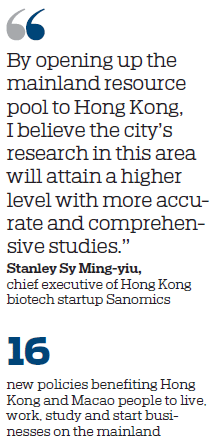
By opening up the mainland resource pool, a treasure house of bio-tech studies, to Hong Kong, he believes the city's research in this area will attain a higher level with more accurate and comprehensive studies.
Moreover, considering the difficulties overseas organizations have in conducting relative research on the mainland, the measure will also help attract more bio-medicine powerhouses to Hong Kong, Sy said.
Professionals benefited
Among the initiatives, six are related to the support of professional services. For the city's construction and engineering sector, the most noticeable measure is enabling qualified professionals to provide services across the mainland. Currently, they can only do so in Guangdong and Fujian provinces as well as Guangxi Zhuang autonomous region.
Lawmaker Lo Wai-kwok, who represents the city's engineering sector, told China Daily the new measures have opened the door of a huge new market for Hong Kong professionals. In addition to first-tier cities such as Beijing and Shanghai, Lo said, many mainland cities have also generated huge demand for construction services due to the rapid urbanization of China.
In addition to large-scale infrastructure projects, potential demand also exists in projects relating to commercial residential buildings, urban renewal and environmental improvement, Lo said.
Hong Kong legal practitioners in certain fields will also be allowed, after passing a special examination, to practice in the nine partner Bay Area cities on the mainland.
Legal expert Thomas So Shiu-tsung said the measures were expected to greatly benefit qualified Hong Kong legal practitioners when they enter the Bay Area. The region has a population of more than 70 million - nearly 10 times that of Hong Kong.
Currently, Hong Kong lawyers who want to practice on the mainland have to pass the National BAR Examination, said So, the former president of the over-10,000-member Law Society of Hong Kong. This is a comprehensive test requiring knowledge of all-around legal matters.
So said the special examination tends to have higher requirements for applicants and demands more specific knowledge. He noted it is a widespread routine among global legal communities to allow overseas practitioners to join local businesses after passing special tests.
bingcun@chinadailyhk.com
(HK Edition 11/08/2019 page4)