Bridge to 'stand the test of time': Chief engineer
Updated: 2018-10-23 07:02
(HK Edition)
|
|||||||


Crediting 50,000 construction workers and engineers with an achievement he led, Su Quanke is pleased with the outcome. He Shusi and Luis Liu report
Su Quanke, chief engineer of the HZMB Authority, which operates the Hong Kong-Zhuhai-Macao Bridge, ushered in his team for a final check on the bridge's structural integrity. It was a part of the process of final acceptance for the massive project.
Getting to the inner workings of the bridge was no easy task. It required a climb over the roadside barriers between traffic lanes, down a narrow, steel ladder, looking straight down at the choppy ocean waves 40 meters below. Every step required great caution, against the strong sea winds.
After going inside, people have to walk on narrow and jagged steel meshes to go across from one section to another. No lighting was installed during construction. Su and his team had to rely on portable lights making their way along the narrow, mesh walkways to examine the work.
The inspection took hours, starting at noon and ending in the late afternoon. Su halted every five paces, checking almost everything from the smoothness of a section of troweled cement, to the arrangement of a set of wires. His eyes darted about, seeking what he called "imperfections".
|
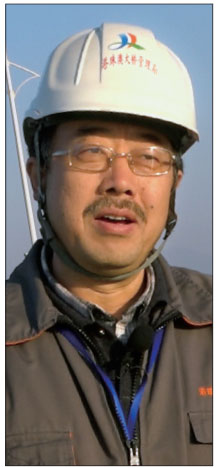
Chief Engineer of the Hong Kong-Zhuhai-Macao Bridge Authority Su Quanke, who has devoted his career to various bridge projects in China, sees quality the most important element and the integrity of a bridge project. Miriam Zhang / China Daily |
"The water pipes have to be double checked. Any slight leakage cannot be allowed in the area," he directed colleagues.
Once the interior inspection was complete, Su returned to the roadside, to examine the anti-collision roadside barriers along the bridge. Those barriers are meant to prevent cars, involved in mishaps from being propelled into the ocean, far below. Su doesn't tolerate a single misplaced piece.
"Those are the real factors that determine the bridge's integrity," Su said.
He had made checks like this every day on his own, inspecting different parts of the bridge. After the final check, he felt assured, at last. The project "has met all expectations" in every technical standard, Su told China Daily in an exclusive interview.
He credits the success to the efforts of about 50,000 construction workers and engineers. The HZMB, the world's longest sea crossing, is capable of "standing the test of time", Su said.
Life on bridges
The 56-year-old bridge engineer sees the bridge as the premiere project of his career. He's devoted more than a decade to the once-in-lifetime project, and feels gratified that he met the challenge.
"After years of work, I would say the bridge is a convincing result to the people of China and the world."
Su has worked on bridge projects for almost 30 years. "I have very close bonds of affection with bridges. And I see quality as the most important element, as important as my life," Su said.
"If I failed to build something well enough, my efforts would just be worthless."
Su was responsible for the quality inspection of bridges in the Guangdong province in the 1990s. He's seen many poor quality projects, and that made him anxious about the future of Chinese bridge engineering, back then.
"The country had very limited budget due to its developing economy. At the same time, there was a demand for solid infrastructure in a hurry." Su said. Thus, a whole generation of construction workers had to build many bridge projects hurriedly, without good engineering equipment or quality materials. They were fully reliant on their wisdom and perspiration.
Su also recalled when a bridge expert from Hong Kong compared different parts of the Shenzhen Bay Bridge - built half by mainland workers and half by builders from Hong Kong - slide by slide, showing the rough edges of the part built by the mainland.
He admitted that, at the time, international reproof of some of China's infrastructure quality made him determined to make each and every project that he worked on, world-class.
"Back to the basics, you can never joke when lives are at stake," he stressed.
Now it's time
With the achievement of 40-year reform and opening-up, the country has made substantial progress in engineering, material manufacture, technical experience. During the process many outstanding engineers have developed, Su said.
Now we build our projects not only on the need for transportation but also meeting the demand for high quality, long sustaining, aesthetically pleasing projects, conveniently maintained, he said, with a touch of pride.
There were difficulties. Some contractors came to Su to asking to lower the standards. He said no and he's never regretted it.
"With previous failures in mind, the team members [of HZMB] had their ambitions bottled up and they were determined to build something good to restore credit for Chinese engineering," Su said.
Even with the world's leading technologies at their disposal, Su and his team faced unknown factors building the world's longest bridge-island-tunnel complex.
The 6.7-km subsea tunnel alone is China's first-ever, offshore immersed tunnel and the world's longest for handling vehicular traffic. The construction team had limited marine data on the Pearl River Estuary, to work with. There had been no marine works in the area prior to the HZMB project.
Asked how many experiments they had taken to accomplish what they'd never done before, Su reflected over 14 years of preparatory work and construction. "Conservatively, at least 300 times," Su said. Actually, it normally takes just dozens of experiments building a sea crossing in China, Su said.
"The number of experiments we carried out to build HZMB is definitely the most in China's bridge engineering history. And it was also a remarkable feat in global engineering."
He credited the role Hong Kong played in the development. "Hong Kong's international ties and close relationship with the mainland helped us integrate global resources to achieve something greater in the HZMB project," Su added.
Taking the project as a whole, Su said he felt confident that the HZMB is unsurpassed and will not fail the expectations of the people.
He cautions, however, against China's engineers becoming complacent. The country still faces developmental challenges. Su said one or two world-class bridges could serve as models but fundamental improvement relies on the country's further advance in the overall economic and industrial development, he added.
Pursuit of better life
The HZMB could also be seen as reflecting the standard of Chinese people's ever-growing need for a better life.
Quoting the report of last year's 19th National Congress of the Communist Party of China, which highlighted endeavors to build a better life, Su said, as the economy has developed and productivity has increased, Chinese people have started paying more attention to quality.
"HZMB is the result of such pursuit," Su said. "I'm confident after 10 to 20 years, bridges built in the least developed areas in China can be as good as the world's first-class," Su said.
Stressing that it takes the efforts of several generations to improve the overall quality of bridges in China, the 56-year-old said he felt lucky to be a bridge engineer in the 21st century - a time where people are provided with the opportunity and resources to build the world's longest sea crossing.
Su climbed out of the body of HZMB, declaring the project can withstand the test of time.
Contact the writers at
heshusi@chinadailyhk.com
|
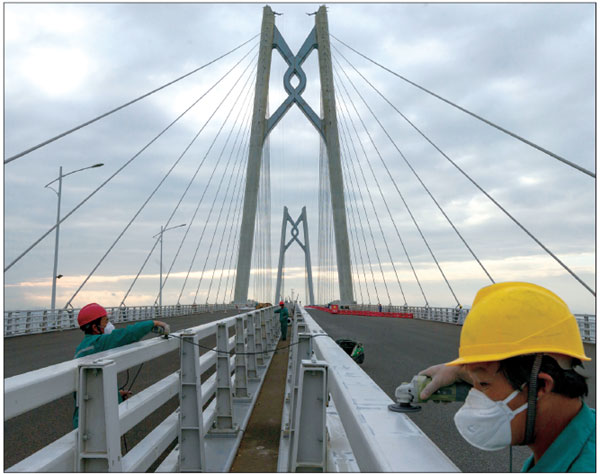
Construction workers finalize their work at the Hong Kong-Zhuhai-Macao Bridge last November before the final acceptance check. The bridge operator kept stressing its focus on quality throughout the whole construction process. Roy Liu / China Daily |
(HK Edition 10/23/2018 page6)