MPF rules should be modified to better meet workers' needs
Updated: 2016-06-20 08:13
By Fung Keung(HK Edition)
|
|||||||


David Wong Yau-kar, chairman of the Mandatory Provident Fund (MPF) Schemes Authority in Hong Kong, suggested recently that workers should be allowed to use their contributions to their MPF accounts to buy flats. Hong Kong citizens should embrace this good idea with open arms.
Wong said using employees' savings to buy flats would not breach the principle of "accumulating wealth" for people's retirement. (Properties are part of wealth.) He insisted that owning property already provides some protection for retirement.
The MPF scheme was launched in 2000, covering most of Hong Kong's working population. Both employers and employees are required to contribute 5 percent of employees' salaries to their MPF accounts, capped at HK$1,500.
Take myself as an example. I have saved about HK$500,000 in my MPF account since 2000. Unfortunately I am not allowed to use the money to buy a flat. By the time I am 65, I can withdraw the money from my MPF account to buy a flat, but by then property prices might have skyrocketed to a level far beyond my affordability.
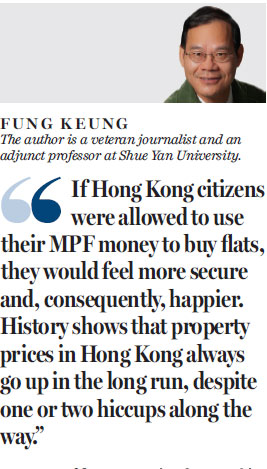
If Hong Kong citizens were allowed to use their MPF money to buy flats, they would feel more secure and, consequently, happier. History shows that property prices in Hong Kong always go up in the long run, despite one or two hiccups along the way. This is just common sense.
Another policy the government should consider is to increase the level of MPF contributions. Since the contributions are tax free, most people will contribute more to their MPF accounts if they are allowed to. Perhaps the government could boost the monthly contribution to 10 percent of employees' salaries, capped at HK$3,000. As Hong Kong's population is aging, an enhanced retirement protection plan is always welcome.
Meanwhile, the current practice which allows employers to use their MPF contributions to offset severance and long-service payments should be scrapped. It is understandable that a majority of business groups oppose the abolition of the MPF offsetting scheme - a recent survey showed that about 85 percent of firms oppose it - because this mechanism only benefits employers.
The Hong Kong Federation of Trade Unions, which favors the abolition, has rightly argued that the MPF is a totally separate thing from severance and long-service payment, and labor retirement protection will be reduced if the offsetting mechanism continues to operate.
Business groups contend that the abolition of the offsetting mechanism would increase their operational costs, reduce competitiveness and worsen employer-employee relations. Be that as it may, the government should ignore business groups' demands.
To protect workers and make them happier, the government should amend the MPF ordinance to allow them to use their money in their MPF accounts to buy flats; abolish the offsetting scheme which benefits only employers; and increase employees' contributions to their MPF accounts.
All these measures would not reduce Hong Kong's competitiveness since happier workers would be more effective and productive.
(HK Edition 06/20/2016 page1)