Why is there such strong tolerance for babel in the heart of the city?
Updated: 2016-06-06 07:59
By Jon Lowe(HK Edition)
|
|||||||


When was the last time you walked at night through Lan Kwai Fong, D'Aguilar Street or upper Wyndham Street? It may be that, like many other people, you have long avoided them. Despite their renown as Hong Kong's premier nightlife area, walking around there gets quite unpleasant from about 9 pm onward - not due to the hordes of young revelers drinking and getting rowdy, but the horrible din that reverberates throughout.
Twenty years ago, Lan Kwai Fong and D'Auguilar Street were just as busy, but it was possible to stand in the open and have a conversation without having to shout. This is because the sound systems were confined to the interior of bars and clubs. Even if the doors were open, the music remained well in the background if you were standing outside. At some point, some bars decided to blast their speakers out on to the street, and soon many others followed suit. The result is a cacophony of different songs, from thumping techno to screechy 1980s power pop - all combining in what can only be described as a sonic hell, made worse by the narrow streets and high density of establishments.
Aside from being an aural train wreck, I am sure that hearing many different songs blasted at you at the same time is not good for your mental balance. I would not be surprised if such auditory unpleasantness were used to psychologically "soften up" terror suspects for interrogations in nefarious secret bases around the world. It may even cause unhinged behavior in Lan Kwai Fong regulars. Obviously, any residents close enough to complain have been driven out or otherwise placated. If no residents complain, the police will not intervene - everything is considered to be fine. But by raising the volume, Lan Kwai Fong's bars and clubs have considerably lowered the tone. It keeps many away - both Hong Kong people and tourists - despite few similar nightlife options in the city.
When you compare it with the famous areas of other major cities, such as Soho in London or La Rambla in Barcelona, there is a marked difference. Those places are busy with revelers too, but the sound environment amounts to a pleasant hubbub, encouraging people to leisurely stroll and chat. Occasionally one may come across a live street performance and stop to listen for a while - undisturbed by any competing music spilling out of bars. Inside the venues there is live music, piped music, DJs playing records - while out on the street there are plentiful diversions to be enjoyed in relative peace. In London's Soho, there has even been a boom in trishaws, a popular option for lovers. But imagine the trauma a trishaw circuit around Lan Kwai Fong could inflict on a budding romance!
In Hong Kong there is, thank heaven, the SoHo area, a calmer network of lanes centered on Staunton Street and Elgin Street, where music is kept at reasonable levels conducive to conversation. This area, though, has suffered from the opposite problem to Lan Kwai Fong. A few years ago, Peel Street in SoHo was home to two jazz bars and an Afro-beat club. It was a popular meeting place for many people, from high fliers in the banking world to tourists and musicians. But in the last five years it has petered out following a relentless campaign of noise abatement. The live music venues made serious efforts to soundproof their premises - but then the noise of people interacting in the street became the focus of complaints. Seats were brought inside and notices were put up by the bars. Inevitably, people looking to let their hair down were put off by the now stressful aura and the flow of punters began to dry up. Two of the live music venues called it a day. There remains one jazz club struggling on, which has been ordered to end all performances by 11 pm - even though the music within, in the vast majority of instances, cannot be heard outside.
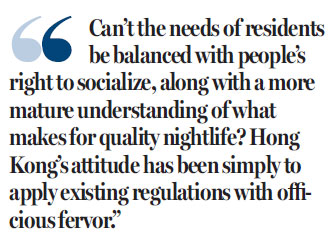
Taking residents out of the equation for a moment and sticking to aesthetics - which are very important for a city's well-being and reputation - it is baffling that we tolerate the most headache-inducing racket in Lan Kwai Fong while obsessively policing quieter areas that are not guilty of producing anything like the same noise pollution. In the process, a pocket of the city that had something creative to offer - live music rather than just booze and house music - has been almost snuffed out. Can't the needs of residents be balanced with people's right to socialize, along with a more mature understanding of what makes for quality nightlife? Hong Kong's attitude has been simply to apply existing regulations with officious fervor. But more careful thought should be given to improving the aesthetic character of our entertainment areas.
The author is a seasoned journalist who has worked in many places in the world.
(HK Edition 06/06/2016 page8)