Up to the highest height
Updated: 2016-06-03 07:41
By Dara Wang(HK Edition)
|
|||||||


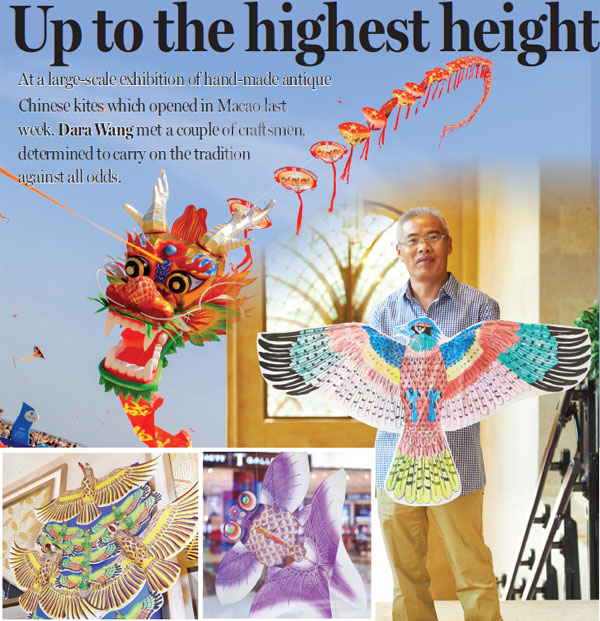
At a large-scale exhibition of hand-made antique Chinese kites which opened in Macao last week, Dara Wang met a couple of raftsmen,determined to carry on the tradition against all odds.
At a spectacular kite exhibition which opened in Macao last week, all eyes were on a giant dragon-shaped kite which had earlier won the top award for innovation at the 33rd Weifang International Kite Festival. The dragon head of the kite was 3 meters long. The 333 "scales" on its 1,000-meter-long dragon body carried images of scenes from the ancient Silk Road. It was easily among the top draw at the Flying High exhibition at Galaxy Macau, possibly the largest showcasing of antique, handmade Chinese kites in the SAR.
Wang Zheng, a young kite-maker from Weifang, Shandong, was among the 10 craftsmen who had spent a month, putting it all together. Numerology played a major part in determining the shape and length of the kite. As Wang explained, "In ancient Chinese belief, three was not only a number. It contained the meaning of 'many'. So a 3-meter-long dragon head symbolizes long-lasting prosperity."
Wang, 27, and Li Baoquan, 43, brought 60 kites all the way from Weifang, popularly referred to as the kite capital of the world, over to Macao. Wang and Li are among the dwindling number of craftsmen trying to keep the tradition of hand-made kites alive, struggling against the competition from mass production. Wang, who is possibly the only kite-maker of his generation, got emotional talking about the moral responsibility he felt towards passing on the legacy.
"Kite-making techniques have been handed down for several hundred years. As a young person of Weifang, I have the responsibility to pass on these techniques to the next generation. Although the process of learning might sometimes seem rather dull and difficult, someone has to stick to tradition," Wang said.
Wang drew his inspiration from his mother, also a maker of hand-crafted kites. He majored in landscape design in Tianjin University and now applies his sense of design to kite making.
Moving with the times
The know-how Wang inherited from the masters of the craft is as intricate as it could get. At the core of the contraption is a bamboo framework. Being flexible, a bamboo frame could be made to bend at different angles when roasted. It's the technique used to get the curved outline of a dragon head.
Making the skeleton of the kite is the toughest part. Craftsmen cut out long, straight, smooth pieces from high-quality bamboo. Each piece is well-hewn before being slit down the middle to help inter-lock with the rest and roasted - a meticulously detailed process, called binding in kite-making parlance. Wang says it takes an apprentice at least three years to accomplish the task independently.
"Some customers purchase only the bamboo-made framework of a dragon kite as the skeleton displays the expertise of kite-makers," said Wang.
Over time, kite-makers too have adopted smarter, more eco-friendly, ways of continuing the tradition. "As dragon kites are enormous, the material pasted on the framework needs to be light," informs Li. "To make transportation easier, we have made the dragon head detachable, which necessitates it be made of sturdy material."
Propylene, an environmentally-friendly material, is commonly used to paint the kites nowadays.
In recent years Weifang International Kite Festival has seen kites with figures of cartoon characters Spongebob and Doraemon. It's common to find LED-lit lightning-shaped kites at the show. The increased application of technology is putting the traditional craft of kite-making at greater risk.
"We cannot stop modern adaptation of traditional kites," says Wang. "We can only try our best to make sure the traditional technical inheritance is maintained in such adaptations," said Wang.
"As kite-making techniques were mainly taught by word of mouth, many traditional skills are already lost," he adds. His teacher Wang Yongxun would collect old kites from around the world to keep a record of different traditional techniques. The old kites displayed at Galaxy Macau are all from master Wang's collection.
He attributes the younger generation's lack of interest in kite-making to the fact that it is not a hugely profitable profession. "I had nearly no income when I started learning kite making," says Wang. "We need to make people realize that the importance of kite-making lies beyond an opportunity to make money."
"Though the kite is tiny, it can have the whole sky as its playing field," he says, philosophically, encouraging more youngsters to experience the sheer delight of handling what must be one of the world's oldest playthings.
The scenario has begun to look a bit more promising since the local government in Weifang began sponsoring several training institutes and started offering kite-making programs at schools and universities.
"Many students now realize the importance of kite-making as a craft. We are glad to see more and more youngsters taking a keen interest in kite-making," said Li, a seasoned hand in the business.
|
(Clockwise from top left) The 1,000-meter-long dragon-shaped kite at the exhibition in Galaxy Macau had 333 'scales'; Li Baoquan treats each of his creations like a caring parent; traditional goldfish and soaring eagle-shaped kites were popular with the viewers. Photos provided to China Daily |
(HK Edition 06/03/2016 page5)