How many kids can fit in a matchbox?
Updated: 2016-05-31 07:32
By Ming Yeung(HK Edition)
|
|||||||




|
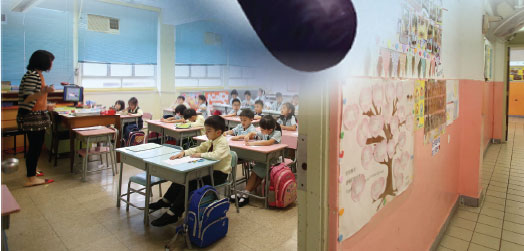
Students and teachers in matchbox schools are bothered by noise generated from classrooms on both sides of the corridor. Photos by Parker Zheng / China Daily |
|
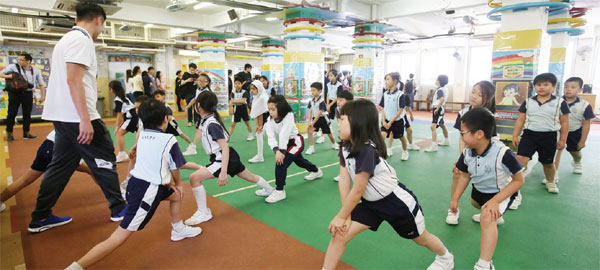
Students have physical education lesson in covered playground where there are eight large pillars. |
|
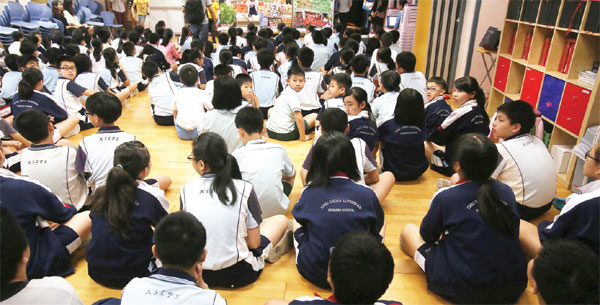
There is hardly a place big enough to gather all students and teachers together in matchbox schools. |
|
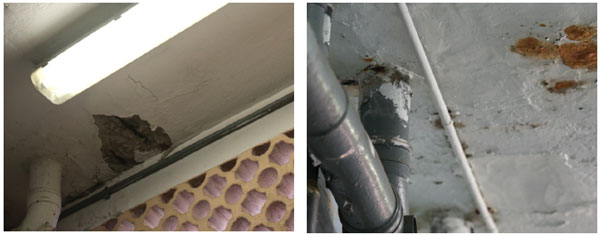
Structural damages are dangerous for students and staff of matchbox schools. |
The tiny schools built alongside public housing estates more than 40 years ago are slowly crumbling. Despite the fact some may present physical danger, the solutions continue to elude authorities. Ming Yeung reports.
When students at ELCHK Kwai Shing Lutheran Primary School play basketball, they've had to learn to dodge, not just opponents, but the eight large pillars that hold up the building. The covered playground is the school's only recreation area. Despite the obstructed field of vision, the kids seem agile enough.
This is the area where students have after school activities like cheerleading, rope skipping, etc. The place where they used to play hopscotch, has been overtaken by a small plot of dirt, where the kids learn about gardening.
"A simple game like hopscotch for matchbox schools is a luxury," commented Tsui Hei-lai, principal of ELCHK Kwai Shing Lutheran Primary School. "Although we have a covered playground, we don't have an outdoor playground. There is no place in our school where we can gather all students and teachers together." A tuck shop and cafeteria are completely out of question.
The primary school in Kwai Shing falls well below the standards commonly expected in a normal primary school. It's one of 28 remaining matchbox schools, cuboid and starkly rectangular. All have 24 classrooms, six-stories, and all are attached to nearby public housing estates. Eighteen of them are situated in the New Territories. There are nine left in Kowloon. There's one on Hong Kong Island.
Matchbox schools sprang up between the mid-1960s and 70s on public housing estates, to make room for the rapid increase in student enrolments back then.
They share in common, bad ventilation, falling masonry, frequently plugged toilets, and on top of that, they don't meet fire safety standards. The administration pays out millions of dollars in maintenance costs, just to hold them together. It has cost the Education Bureau more than HK$66 million to keep papering over the cracks - with 60 percent of that amount spent since 2014.
Education Bureau guidelines specify that primary schools should range from 4,000 to 7,000 square meters. From 10 to 14 special rooms should be set aside for music or other activities. Some of the matchbox schools are only 1,000 square meters with no more than two or three special rooms. About 100 schools citywide are over 30 years old whose floor spaces are below 3,000 square meters.
In April, Lam Tai-fai, chair of the Legislative Council's panel on education, and some lawmakers, joined Under Secretary for Education Kevin Yeung Yun-hung, to visit three matchbox schools in Kwai Chung to get a firsthand look at the hard realities.
Principal Tsui led the visitors to a room used for speech therapy, education psychology, morning prayer, and meetings with parents. "The situation is most undesirable because there is not much privacy here but we don't have space," Tsui said. "We get used to shuffling places from time to time, for different things."
Inadequate facilities
Designed without any consideration of acoustics, students and teachers are bothered by all the noise generated from classrooms placed on both sides of a central corridor. "Our students really have to concentrate if they're not going to be disturbed by the noise," said Tsui, raising her voice to compete with the sound of students reciting a Chinese poem in a nearby classroom. The school keeps the fire door open. It's against the law but it improves the ventilation in the otherwise stuffy corridor.
"These schools were barely equipped, much like the early Ford model-T - a vehicle that can provide basic transportation but nothing more," according to a study called From "Rooftop" to "Millennium": the Development of Primary Schools in Hong Kong since 1945.
Sharing schools' sporting facilities with the residents of the housing estate is common but that could be dangerous for the students. There's no way schools can prevent anyone, including strangers, from coming into the school.
Ng Woon-ling, headmistress of SRBCEPSA Lee Yat Ngok Memorial School, said the school has to deal with other problems when facilities are shared in common with the local neighborhood.
"People walk their dogs here and do other things, so on Mondays our staff is busy cleaning up. There is nothing we can do about it," Ng sighed. "We have to place a staff here to keep an eye on our students."
Structural problems are the most dangerous for students and staff. The principal of CNEC Ta Tung School, Simon Wong Siu-chiu has watched cement peel off the walls and fall to the ground. The original contractors used salt water when the building went up in the 1970s. Pointing to layers of paint on the ceiling, Wong explained the "patchwork" was due to the bursting of steel bars in the concrete. Rows of light pipes have fallen to the floor in the past. Fortunately, no one has been hurt so far. The school has needed emergency maintenance several times over last 45 years.
Chronic problems persist
No matter how frequently the school undertakes maintenance, chronic problems persist.
The walls of stairways are open and decorated with grille panels. The rain pours in and the floors get slippery. The school is not allowed to cover over the grille panels.
Compared with the "millennium" schools which usually have 24 or 30 standard classrooms, a basketball court, a library, language rooms, special rooms, networked computers and multimedia facilities, students from matchbox schools are denied possibility and space to fully develop their potentials, principal Tsui said.
"These problems affect the learning and development of students, and create the need for additional manpower and require administrative work for the staff," added Tsui.
She hoped the meeting with officials would provide solutions for short, medium and long term for matchbox schools.
"We need extra subsidies for schools to do maintenance work, and we expect there will be a tripartite meeting to discuss redevelopment or relocation. In the long run, we hope there will be a blueprint and a timetable for a complete replacement of matchbox schools," Tsui suggested.
After the visits, Lam Tai-fai announced that the panel, the Education Bureau and the education sector would discuss how to tackle the problems in meetings scheduled before the end of the current legislature term.
"Hong Kong is a knowledge-based society, so I believe the government should be responsible to tackle the problem," Lam noted.
Kevin Yeung said that the authorities will look into the current criteria considered for the redevelopment of schools. The present approach considers school environment, facilities, quality of teaching and future plans of the school.
Yeung acknowledged the deficiencies of matchbox schools. Right now priority is given to schools planning to shift from half-day to full-day operation. He declined to comment when asked whether the intent is to find solutions by the end of the current administrative term.
"Before we can relocate these schools, we must think about how to deal with design problems such as the grille panels and how to reduce noise," Yeung said.
Stanley Chan Chi-yuen, a member of the Subsidized Primary Schools Council, has urged the government to think of other alternatives and to prioritize relocation of these schools instead of pouring in more money for maintenance work.
"Why do we have to keep pouring in money? Is it necessary? I believe we can sort out a way to solve it," Chan said.
Contact the writer at mingyeung@chinadailyhk.com
(HK Edition 05/31/2016 page10)