Incredible Indian achievers
Updated: 2016-02-03 08:27
By Chitralekha Basu(HK Edition)
|
|||||||


As a high-profile business delegation from HK visits India, we bring you the stories of a few people who play key roles in steering the long-sustained HK-India ties forward. Chitralekha Basu reports.
Amitav Ghosh's most recent novel, Flood of Fire, ends with a scene in which the land on Hong Kong Island is being auctioned to a phalanx of new settlers, following the end of the first Opium War in 1842. Some of the people in that motley group were from India - the widow of a deceased merchant ship owner from Bombay (now Mumbai), for example.
The Indian presence in Hong Kong is at least 175 years old. Even before the families of the Kadoories, Ruttonjees and Harilelas arrived here from India's west coast and established themselves as the city's entrepreneurial giants, Indian soldiers and sailors were conspicuous on Hong Kong's shores. Until the end of World War II, Sikh policemen formed the majority of Hong Kong's armed forces.
The traffic of Indian immigrants to Hong Kong nowadays mostly comprises professionals in white-collar jobs, although traders and industrialists couldn't be doing too badly either. The over 1,500 Indian companies registered in Hong Kong are catering to the myriad needs of Hong Kong people, from restaurants and beauty parlors to transportation and information technology. In 2014, trade between India and Hong Kong was HK$190 billion, according to InvestHK figures.

Beginning again
Harindarpal Banga might be credited for having a role in the India-Hong Kong growth story. Born in Amritsar, Punjab, Banga came to Hong Kong via London, in 1984. He had a background in both shipping and logistics industries and in 1989 co-founded Noble Chartering Limited, an arm of the Noble Group - a platform for managing global supply chain of commodities. Two years back, the man whom Forbes Magazine in 2012 listed as the 45th-richest in India, founded his own asset management, logistics and commodities trading company - The Caravel Group.
In a sense it was a bit of a dj vu, starting over at an age when people normally think of retiring. In fact, the stakes were much higher compared to 1989, says Banga. "The challenges are very different. While that was a small startup, today I am heading a mega billion-dollar balance sheet company. There are 4,000 people working in Caravel worldwide," he adds.
Even as his company rakes in the revenue, Banga is keen to extend the benefits to those who could make use of it in India. "We are working towards providing education in India, where youngsters can be employed in the global businesses that we carry. They will be the next batch of cultural and trade ambassadors for the country."
As the president of the forum of Indian professionals in Hong Kong, Banga enjoys the role of nurturing the Indian youth who come over to Hong Kong to fine-tune and enhance their qualifications. "Fifteen years ago you hardly found any Indian student studying here," he notes. His team is happy to hand-hold the MBA and PhD aspirants enrolling at University of Hong Kong or Chinese University of Hong Kong as they settle in. "We try to give them a lot of support and advice, be mentors to them, help them find a career and a home here," adds Banga.
In 2011, Banga received the Pravasi Bharatiya Samman Award from the Indian President for having made his country proud in terms of personal success, enhancing the prestige of India abroad and looking after the needs of overseas Indians. The prize also brought him an augmented sense of responsibility in its wake.
"Before I was conferred the award, I had nothing at stake. Now because of the award I have to put in double the effort to make sure that I deliver up to a certain standard. Before what I did (for welfare) was the by-product. Now what I do for my countrymen is the main thing," says Banga.
On Xuanzang's trail
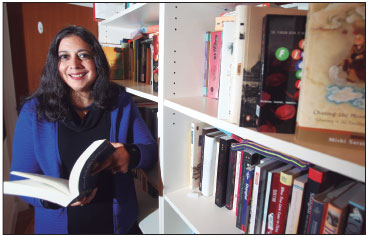
Mishi Saran keeps coming back to Hong Kong. She was present here to witness some of the city's most defining moments - the robust growth years in the mid 1990s, the excitement and tension over the handover in 1997 and the 79-day occupations of the city's major thoroughfares in 2014.
Indian-born Saran was here as a fresh graduate in 1994, following in the footsteps of some of her fellow students from Hopkins-Nanjing Center for Chinese and American Studies, where she had been building on her BA in Chinese Studies from Wellesley College, the United States. She had arrived here with a backpack, looking for a job, and found one almost immediately as a reporter with a news agency. "The economy in the mid 1990s was booming," recalls Saran. "A knowledge of Chinese was a huge advantage, for I had pretty much no other skills," she adds, downplaying her obvious credentials which would shine through some years later with the publication of a remarkable book on the Buddhist monk Xuanzang's (CE 602 - 664) travels through India and Central Asia.
Chasing the Monk's Shadow (2005) is based on Saran's journey, following the trail Xuanzang had left 1,400 years ago. It was an ambitious project, not only because the monk had traveled for 18 years covering a terrain that was as vast as it was varied but also because parts of it (including Taliban-dominated Kabul) would, by common reckoning, be considered off-limits for a young woman, traveling solo. "But when you're 32, you don't think too much about the consequences and just follow your ideas," says Saran.
Saran received a generous grant from Hong Kong Arts Development Council which partially funded her travel and came back to the city to write her book over two years. What kept her going, and still does, was a slow-but-steady pace of progress (she is currently inspired by the Hong Kong tram, Saran adds) and the spiritual connection she felt with the monk. "I had a feeling Xuanzang must have faced issues similar to the kind I faced."
A fine balance
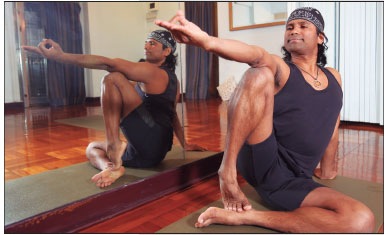
Yogaraj CP arrived in Hong Kong at a critical moment in 2003, when the city was just about trying to find its feet in the aftermath of the devastating SARS crisis. "It was a good moment for yoga practitioners, as the city had become extremely health conscious," he recalls.
The Chennai lad, who had made yoga a part of his life at age 5 as a way of paying homage to his prematurely-deceased father, and became a state champion at 12, turned over a new leaf at 17 as a yoga teacher in Hong Kong.
"When I first started giving lessons at City University of Hong Kong, there were only six students," says Yogaraj, who teaches a multi-cultural group of expats, Chinese mainland and Hong Kong people. "The number of students has increased steadily with each new semester. Now whenever they announce a yoga class, immediately the quota of 50 students fills up."
He has two Guinness World Records under his yoga sash: for doing yogic demonstrations on a moving motorcycle and again, quite recently, for performing 1,500 asanas (postures) for 40 hours and 15 minutes non-stop.
Keen to hand down the techniques he has honed to perfection to the younger generations, Yogaraj would like to take his classes to Hong Kong's schools. Yoga was made compulsory in Indian schools recently, he points out. "Likewise, I would like to have a role in introducing yoga to school curricula here. I am sure if they started now, the young generation of Hong Kong will grow up to become more disciplined, confident and have a healthier lifestyle."
|
Mishi Saran wrote her book on Buddhist monk Xuanzang's travels to India and Central Asia in Hong Kong. Parker Zheng / China Daily |
|
Yogaraj CP would like to promote the Indian art of holistic living in Hong Kong's schools. Parker Zheng / China Daily |
(HK Edition 02/03/2016 page9)