Penning a business
Updated: 2014-12-01 06:37
By Sophie He(HK Edition)
|
|||||||


|
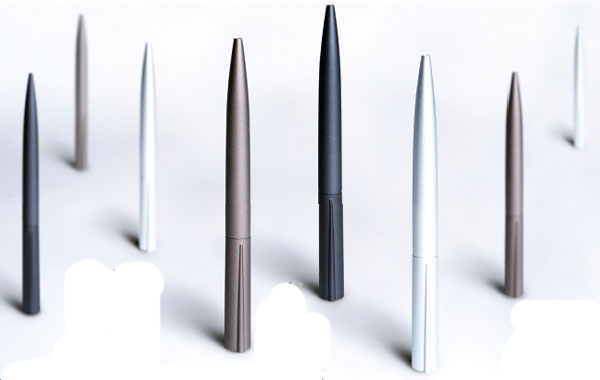
USB Ballpioint pen, a product created by ten Design Stationery, is to push the body shape to the slimmest limit against the width of a USB flash. Provided to China Daily |
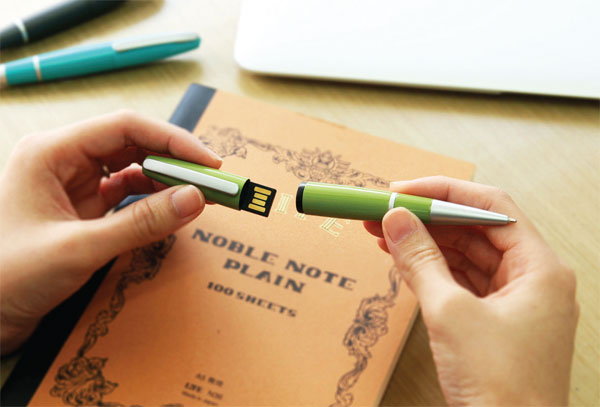
A product designer has made his mark with a ball pen, attributing his success to what he calls an inexhaustible passion for designing stationery, Sophie He reports.
Paul Lam was a product designer at a ball pen original equipment manufacturer (OEM) factory before he helped the company launch its own stationery brand, ten Design Stationery, in 2010.
Ball pens manufactured by ten Design Stationery are now being sold at some of Hong Kong's prominent retail store chains like City Super and Page One, for between HK$200 and HK$600 each.
Each year, some 10,000 to 20,000 ball pens made by the company are sold to customers, Lam told China Daily.
He said the inspiration for the company's name came from the Japanese language - the pronunciation of "ten" in Japanese means "a point".
"Writing begins from a point; hence, we use 'ten' as our brand name to convey the meaning of a 'start-up'."
Lam majored in electronic engineering at Hong Kong Polytechnic University. After graduation from the university in 1998, he worked for a local toys company for more than two years before joining Wah Fook Holdings Ltd - a local firm that owns an OEM stationery factory in Shenzhen, employing some 150 workers.
Lam used to be in charge of design and product development at the factory but, after working for the firm for 10 years, he proposed to the factory's owner that they should have their own stationery brand instead of just making products for European and US customers.
"Competition was very intense and costs had kept on rising" he explained, adding that in the past decade, more OEM factories have opened up on the mainland, offering very cheap prices to lure customers.
"But, we can't keep lowering our prices while maintaining the quality," said Lam.
The ball pens made by the factory were selling for about $1.50 each.
Wah Fook set up ten Design Stationery in 2010 to develop its own brand. Lam, as the manager, with two other colleagues, started to design for their own.
It took them six months to design and produce their first ball pen. The pen's appearance was very simple but thoughtful details had been put into it.
Lam and his colleagues took their first product to ISOT - one of Asia's largest-scale stationery and office products trade shows in Japan.
The product caught the attention of many at the show and positive feedbacks were received. More importantly, it aroused City Super's interest.
City Super, which attended the trade show in Japan, ordered 300 ball pens from Lam's firm to sell them at its chain stores in Hong Kong.
International award
To further promote the company's products, Lam participated in international competitions and won a Red Dot Design Award. Other retailers in Hong Kong soon noticed that City Super was selling the products and they've decided to do the same.
Currently, ten Design Stationery's products can be found at Page One, InnoCentre, the Hong Kong Trade Development Council's design gallery as well as The Commercial Press.
The company now offers 44 different products, and it is introducing four to five new products to the market every year - from ball pens which are also USBs to ball pens that can be used to write on the screen of smartphones and tablets.
Lam has also brought in several agents to help ten Design Stationery sell its products on the mainland and overseas.
"From what I know, our products are being sold at high-end shopping malls in Beijing, Shanghai and several other major cities on the mainland," he said, adding that the mainland is already the company's number one market as sales on the mainland account for 30 percent of its total sales. Hong Kong contributes 20 percent, the rest of Greater China Area accounts for about 10 percent, with the remainder coming from the US, Japan and Korea.
From customers' feedback, Lam has learned that mainland consumers are slightly different than their Hong Kong counterparts.
Pens as gifts
"Mainland clients would pay extra attention to the packaging, and would like their ball pen to be placed in a larger box so that they can present them as gifts to their families and friends."
But launching a new brand is never easy, Lam argued. "When we were working at the OEM factory, everything was much simpler. We produced according to customers' orders, and we never had to worry about not being able to sell our products.
"But producing our own products, we have everything to worry about - whether the design is good enough, whether it's able to accurately convey our design intent to users, and if the product would become popular in the market.
"Sometimes, it took us as long as six months to design a ball pen, and when we brought it to market, it is like introducing our new baby to the world," Lam said.
He also said that as the company is very small, they don't want to order large amounts of raw materials, but every factory assesses what the minimum ordering quantity would be.
Lam admits that, despite having its own stationery brand now, it made the OEM factory more trustworthy to customers. The financial contribution from ten Design Stationery to Wah Fook Holdings is not significant.
"We contribute around 5 percent of the total sales of Wah Fook," he said
The company plans to enhance its product development in future and focus its resources on Asia, especially the Greater China region.
Lam said he has an inexhaustible passion for designing stationery.
"I couldn't stop thinking about design. When I go shopping out on the streets, whatever I see I'll try to draw an inspiration from them for my future design."
He firmly believes that Hong Kong is an ideal place for designers to start their own businesses, as it's a city where Western and Eastern cultures meet, and the local market is always a testing ground for creative products.
Lam suggests that young designers should get a clear idea of what they intend to do, and who are their potential customers before starting their own business.
"A clear market strategy is very important for young designers, otherwise they will be just running around and wasting resources," he said.
Contact the writer at Sophiehe@chinadailyhk.com
(HK Edition 12/01/2014 page8)