Toymakers to beat rising costs with various tactics
Updated: 2011-01-11 07:19
By Joy Li(HK Edition)
|
|||||||


|
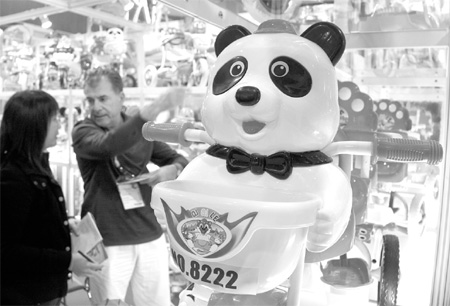
People talk at a booth during the city's Toys and Games Fair. The cost of raw materials for toymaking has increased substantially over the past year. Jerome Favre / Bloomberg |
Rising labor and raw material costs are presenting serious challenges to Hong Kong's toy industry, the industry's association said Monday.
The industry once upon a time helped cement Hong Kong's reputation as a manufacturing center. However, renewed efforts to upgrade technology as well as branding will help players in the sector survive, said David Chu, president honoris causa of the Toys Manufacturers' Association of Hong Kong (TMHK).
However, the cost of raw materials has increased quite substantially over the past year. For example, ABS plastic, one of the base materials in the toy-making industry, has seen its price soar around 40 percent over the past year to almost HK$20 per kilogram from HK$14 per kilogram.
Meanwhile, wage increases have become a prevalent practice on the mainland, especially in the coastal areas. In May 2010, the government of Guangdong province announced it was raising the minimum wage by an average of 21 percent. The average monthly salary in places such as Dongguan and Foshan in the province - where many of Hong Kong's toy makers operate their factories - reached 920 yuan after the adjustment.
"Hong Kong toymakers need to be more creative, develop more brands and upgrade their technology. We also need to look at new markets and developing new niches within established markets," said Chu at a press briefing at the Hong Kong Toys & Games Fair for a new book titled "Toy Town", which recalls the industry's 60-year history.
C.K. Yeung, vice president of the TMHK and vice president of toymaker Blue Box Holdings Ltd, said the industry is responding to the challenge of higher labor costs through automation, as well as capitalizing on skilled workers and technology to enhance efficiency.
Chu said that the toy market has become gradually saturated, a situation prompting manufacturers to control supply, so as to prevent cut-throat competition.
Chu noted that the global toy business had seen seismic changes over the past 60 years, from the advent of television advertising to the consolidation in the number of overseas toy buyers and retailers, the convergence of the toy and entertainment industries, and the rise of new technologies for "smart toys".
"Ultimately for Hong Kong toymakers, to develop globally recognized brands is where the industry should head for in the next phase," said Chu. He noted that more and more Hong Kong toymakers are now moving upstream, engaging in high-value activities such as product design and brand marketing.
According to glokids, an industry information portal, Hong Kong and the mainland account for 75 percent of global toy production. Over 70 percent of toymakers on the mainland are located in Guangdong province, many of them set up by Hong Kong enterprises. A majority of Hong Kong toymakers produce under other brands, or the OEM model (original equipment manufacture).
Government statistics showed that the combined export value of toys, perambulators, games and sports related products were HK$104.9 billion in 2009, accounting for 4.2 percent of overall exports in Hong Kong.
The US and the European Union (EU) are the two biggest export markets, taking up 56 percent of overall orders. However, the latest financial crisis that started in late 2008 has had serious repercussions on these two markets. In 2009 Hong Kong exports to the US dropped 28 percent year-on-year, while those to the EU were down 10 percent.
China Daily
(HK Edition 01/11/2011 page2)