A Macao model
Updated: 2010-12-03 07:14
By Andrea Deng(HK Edition)
|
|||||||


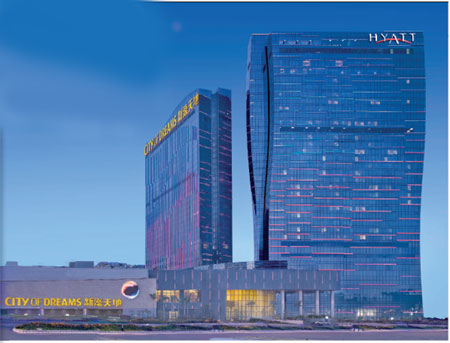
In a city blossoming amid economic transformation, Grand Hyatt Macau is fine-tuning itself with distinct local features.
This year's Annual Conference and General Meeting of The International Association of Anti-Corruption Authorities was held in Macao in early November, attended by political heavyweights from 138 countries - and they were all staying at the Grand Hyatt Macau.
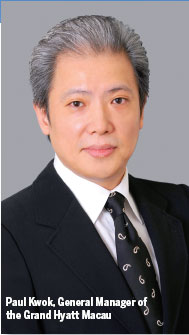
"Macao has never held such a big international conference before," said Mr Paul Kwok, General Manager of the hotel.
And yet this Hyatt brand has been in business in Macao for just one year. In Mr Kwok's own words, "it is still maturing as the business becomes more stable and starts to consolidate."
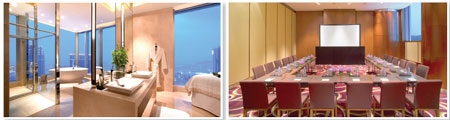
The Grand Hyatt Macau encompasses 96,875 square feet of functional space for meetings and other events, with a capacity of up to 11,520 guests. The entire hotel offers complimentary Wi-fi or broadband connection, and is only five minutes' drive from the Macau International Airport and 15 minutes' drive from the Maritime Ferry Terminal. The major sources of business guests include companies from Hong Kong and multinational companies from the surrounding cities on the mainland.
"The hotel industry in Macao is not like that in Hong Kong, which is a business metropolis. We had to find a solution to fill up the business from Monday through Thursday. Offering MICE service is a way of doing so," said Mr Kwok.
And business opportunities generated by the MICE service (meetings, incentives, conferences and exhibitions) abound, a remarkable feat considering that the Grand Hyatt Macau is just five minutes' drive from The Venetian Macao-Resort-Hotel, a Las Vegas Sands Corp resort which occupies 10,500,000 square feet and contains 1,200,000square feet of convention space, demonstrating that it is hugely competitive in a fiercely contested market.
But while The Venetian relies on its fame as a big player from the Las Vegas, the Hyatt brand looks to its solid global connections for regular business guests, not least in greater China where another 14 Hyatt hotels and resorts are now based. And Macao, as a new Hyatt location, proves its uniqueness in the whole Asian region.
After the Hard Rock Hotel and the Crown Towers, Grand Hyatt Macau is the third hotel of the City of Dreams, an entertainment complex that also contains a mega shopping mall, casinos, and the Dancing Water Theatre which stages spectacular water-based shows. The current performance at the theater - The House of Dancing Water, produced and directed by the world famous Belgium theater director Franco Dragone - has proven to be tremendously popular in the Pearl River Delta Region, thanks to the scores of billboard and broadcasting advertisement campaigns that have been on display since the show's debut in September. Tickets have sold fast, and the theater is not the only beneficiary.
According to Maggie Lee, Public Relation Manager of the Grand Hyatt Macau, the number of leisure guests immediately soars on Wednesday, when the theater's first show of the week is staged. The hotel now cooperates with the theater, offering discount packages containing show tickets, hotel rooms, and a complementary breakfast along with other entertainment discounts.
This complex is just one of the many existing or upcoming entertainment complexes on the Cotai Strip, a Las Vegas Sands Corp-funded reclamation area splicing Macao's two outlying islands, Coloane and Taipa. The area already holds numerous international hotels and casinos including InterContinental, Four Seasons, Sands, MGM, Galaxy - and there are more on the way.
While outsiders might presume that a fierce competition is springing up in the territory, both Mr Kwok and Ms Lee consider the future for the city to be positive as the economy diversifies and becomes more dynamic. They expect attractions to complement one another.
"The Macau Government Tourist Office (MGTO) has been serving as a huge momentum builder that is fueling the further development of Macao's travel industry," said Mr Kwok, adding that the Grand Hyatt Macau is maintaining good relationship with the office, joining road show trips arranged by the MGTO to India, Thailand, Taiwan and Europe to increase the hotel's publicity. The MGTO now has 17 offices worldwide.
However, despite the MGTO's effort to promote a diversified entertainment industry in Macao, the city obviously needs more time to build up towards a full-blown economic sector complemented by adequate transportation and infrastructure.
Entry to Macao, which saw 220,000,000 visitors in 2009, still largely depends on ferries from Hong Kong, which takes approximately an hour each way and round tickets that cost over HK$300. Macao's only international airport offers a limited number of scheduled flights. While there are no shortage of free shuttle buses going from hotels to key attractions, taxis are insufficient. Besides opening up the city to flights to and from more destinations, a highway bridge connecting Macao with Hong Kong and Zhuhai is under construction, the completion of which will allegedly shorten traveling time to only half an hour.
But the outlook in the near future for the Grand Hyatt Hotel depends more on improving hotel standards - a clich in Hong Kong's hospitality industry but a novelty in Macao.
"We're still talking about paying attention to details like using handwritten welcoming cards instead of printing cards, and speeding our check-in and check-out services," said Mr Kwok, explaining that the hotels in Macao used to be seen more as appendixes to casinos rather than stand-alone ventures. The city is still looking to maintain an adequate service standard with the coming influx of such international hotel brands as Shangri-La, Sheraton, Wynn, Ritz-Carlton and Traders.
"If it was not because of the financial crisis in 2009, these hotels might all have begun operations by now," said Mr Kwok.
China Daily
(HK Edition 12/03/2010 page10)