|
Steaming soups
(Beijing Weekend)
Updated: 2005-03-18 17:34
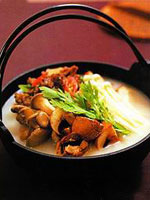 China may be home to the most sophisticated soups in the world. Soup is
not only a soothing and healthy way to start a meal, in China soups often
contain many traditional medicinal herbs. China may be home to the most sophisticated soups in the world. Soup is
not only a soothing and healthy way to start a meal, in China soups often
contain many traditional medicinal herbs.
In Guangdong, where local
people maintain the tradition of drinking nourishing soup everyday, different
soups are designed for people with different physical conditions. It is said the
soups not only help people become stronger, but also help them recover from some
chronic illnesses.
Drinking soup before meals can replenish the body's
needed water, while moistening the gullet and helping dry food to go down more
easily. Soup is also easy to digest and helps prevent problems such as
inflammation of the stomach and intestines.
Soups are especially good for
people living in Beijing because of the often dry winters.
Shenji Best
Soup (Shen Ji Liang Tang) is based in Shanghai. But its Beijing branch has been
serving up steamy bowls of soup for more than five years and offers some of the
capital’s best soups.
With a big red poster above the front gate of the
restaurant’s traditional Chinese architecture, the eatery is quite eye-catching
on Xindong Lu, not far from the Yuyang Hotel.
A look at the menu and one
will discover many representatives of both Cantonese and Shanghai style dishes,
priced from the mid to high-price range. There are also many choices of South
China style xiao chi or small eats at the restaurant.
Although there is
only one page on the main menu listing the soups that are available, there is a
special stand at one side of the restaurant where around 10 different soups are
sold.
Four soups are served in small white pots for one person. These
include crab and Chinese gourd, snake and old chicken, abalone and chicken, and
chuanbei (tendril-leaved fritillary bulb of Sichuan origin) with
crocodile.
Other soups are served in small-sized and medium-sized clay
pots with a big body and a small opening, which are prepared on the spot by the
cooks at the stand.
Different soups can in fact help different ailments,
but eating the wrong soup may do just the opposite.
The restaurant makes
a point of this by listing, on the first two pages of the menu, a diagram about
what soups people with certain physical conditions should drink. But
unfortunately they do not go into enough detail to specify which soups are best
for which conditions.
For the spring, one waitress recommends a pigeon
soup and a duck soup, which she says both clear excessive heat in the body while
replenishing qi or vital energy.
A small-sized clay pot of Kunbu (kelp),
green mung bean and old pigeon soup can be divided into six small bowls, enough
for two people.
The soup is mild but warming. After the soup was
finished, a waitress scooped a surprisingly large plate of pork from the bottom
of the pot. The pork is boiled with the pigeon to make the soup.
The
pigeon cannot be distinguished in the pile of mild-tasting pork because it has
been boiled for more than eight hours, according to the waitress.
The
restaurant's Cantonese and Shanghai dishes are delicious and worth trying. Dou
Ban Hua Zi Gu (cold horsebean and golden mushroom) and Xi Qin Bai Guo Bai He Xia
(shrimp with celery and lily bulbs) are also recommended.
The restaurant
offers adequate service and a friendly staff. An average meal costs about 80
yuan (US$9.69) per person.
Location: To the south of No 1 Xindong Lu,
Chaoyang District
Tel: 6532-1177
|