|
Home>News Center>Photo Gallery>World | |
|
|
|
|
|
|
|
|
|
|
|||||||||||||
|
|
Mount St. Helens Draws a Big Crowd
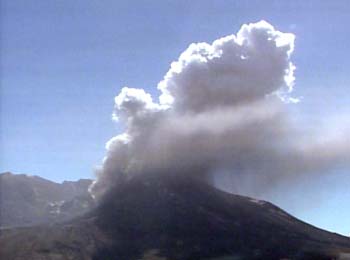
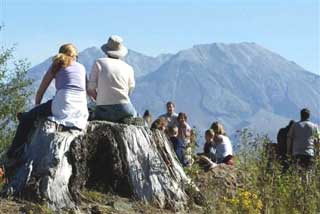
Some volcano experts had said that an explosion would probably happen within 24 hours. But as the hours passed Sunday, others cautioned that the timing is difficult to predict. "No one is predicting it as a sure thing," said Bill Steele at the University of Washington's seismology lab in Seattle. "This could be going on for weeks." Crowds gathered along a park road at what was said to be a safe distance — about 8.5 miles from the mountain — to see what happens next. Barbecues were fired up and entrepreneurs were selling hot dogs and coffee to people camped along the side of the road. "It'd be neat if it spews something over and out," said Chris Sawyer, 40, of Dundee, Ore., who had a large camera set up on a tripod at the Coldwater Ridge Visitors Center.
Scientists said they do not expect anything close to the devastation of Mount St. Helen's May 18, 1980, explosion, which killed 57 people and coated much of the Northwest with ash. "Of course the volcano reserves the right to change its mind," said monument scientist Peter Frenzen with the U.S. Forest Service, which operates the park. The mountain's alert was raised to Level 3, the highest possible, meaning an eruption is imminent. But scientists on Sunday discussed lowering their alert to indicate only that an eruption is possible. "I don't think anyone now thinks this will stop with steam explosions," geologist Willie Scott said Sunday at the Geological Survey's Cascades Volcano Observatory in Vancouver, Wash., about 50 miles south. Many spectators couldn't wait out the mountain, which runs on geological time rather than by the human clock. Sunday's sunset brought a mass exodus off the mountain. "Our attention span is about like this," said James Wilder, 25, of Aberdeen, holding his forefinger and thumb about one-quarter of an inch apart. "We've been here five hours and we need to leave pretty soon." Scientists were unsure how explosive the eruption may be; depending on the gas content of the magma — molten rock — and a host of conditions, it could range from a passive emission to an explosion that throws up a column of ash, Scott said. Besides lava flows, ash and rock-throwing, an eruption could cause melting of the volcano's 600-foot-deep glacier and trigger debris flows to the barren pumice plain at the foot of the mountain. The 1980 blast obliterated the top 1,300 feet of the volcano, devastated miles of forest and buried the North Fork of the Toutle River in debris and ash as much as 600 feet deep. This time, scientists expected populated areas to get little ash if the light west-northwest wind holds. The closest community is Toutle, 30 miles west near the entrance to the park in the Gifford Pinchot National Forest about 100 miles south of Seattle. The main concern was a significant ash plume carrying gritty pulverized rock and silica that could damage aircraft engines and the surfaces of cars and homes.
Steele said the mountain took scientists on a "roller coaster ride" early Sunday when instruments detected the second extended volcanic vibration in two days — 25 minutes long compared to Saturday's 50-minute vibration. "It died off and quickly became a non-issue. But had it been as long as the one following that little steam burst yesterday, we could be moving to an eruption pretty quickly," Steele said. Scientists also detected elevated levels of carbon dioxide and other volcanic gases, including the rotten egg smell of hydrogen sulfide, that reflect changes in the volume of magma rising within the mountain. Gas-sampling flights continued Sunday, and acoustic equipment had been placed around the crater. Dozens of global positioning satellite stations — to alert scientists to changes in ground formation — have been placed on the mountain, though Friday's steam blast destroyed equipment on the 1,000-foot lava dome. Most of the action has occurred beneath the dome, which has been building up
on the crater floor and essentially serves as a plug for magma. The dome is
filled with lava that came up during 1998 earthquakes but never surfaced. New
lava may be coming up as well. |
|
|
|
|||||||||||
|
|
|
|
|||||||||||||