Ensuring AI serves humanity's common interest entails effective global governance: China Daily editorial









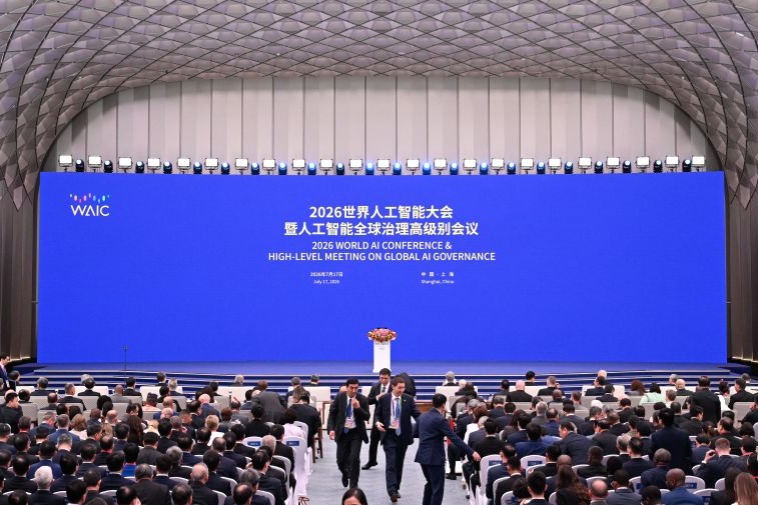
As the 2026 World AI Conference and High-Level Meeting on Global AI Governance opens in Shanghai on Friday, policymakers, scientists, entrepreneurs and engineers are debating a question that will shape the digital age: Who will write the rules for artificial intelligence?
AI has reached a crossroad. One road leads toward openness, shared standards and international cooperation. The other disappears into rival blocs, competing regulations and technological protectionism.
The greatest economic dividends of a transformative technology emerge not when it is monopolized, but when it is widely shared. AI is no exception. Its value does not lie in building the most sophisticated frontier models. It lies in enabling millions of factories, hospitals, schools and research laboratories to apply it.
That philosophy helps explain China's approach to AI governance. Beijing has coupled innovation with large-scale deployment. AI now optimizes manufacturing, assists doctors in hospitals, supports teachers in classrooms, powers autonomous mining operations and improves logistics across the world's second-largest economy.
China on Wednesday rolled out a set of regulations aimed at curbing emotional dependency on AI-powered companion bots. That represents the latest effort of the country to improve its domestic AI governance. Platforms are required to discourage emotional dependency, safeguard personal data, intervene when excessive reliance develops and remind users of the distinction between human relationships and machine interaction. The broader message is that governance should accompany innovation from the outset. That same philosophy increasingly informs China's international agenda.
The country advocates AI for the public good and for the good of all. In 2023, China put forward the Global AI Governance Initiative, which presents a clear articulation of that vision. The initiative advocates a people-centered approach that ensures AI serves human progress rather than narrow commercial or geopolitical interests. It calls for AI development based on mutual respect, equality and mutual benefit, opposing ideological barriers or exclusive technological blocs that deny other countries the right to develop AI.
The initiative supports a governance framework built through broad international consensus, including discussions under the United Nations on establishing an international institution for AI governance. It also proposes risk-based testing and assessment systems to ensure AI remains safe, reliable, controllable and equitable, while emphasizing greater international cooperation to help developing countries strengthen AI capacity and narrow the global intelligence divide.
This agenda deserves attention because if left entirely to market forces, AI risks widening existing inequalities rather than reducing them. So that is why capacity-building has become central to China's international AI cooperation. Through open-source models, technology partnerships and practical projects spanning Southeast Asia, Africa and Latin America, China shows that AI should become an international public good.
China's combination of open-source innovation, manufacturing capability and vast application scenarios has the potential to reduce the global cost of AI adoption, allowing more countries to participate in the intelligent economy instead of merely consuming technologies developed elsewhere.
But algorithms ignore national borders. Cybersecurity threats spread internationally. Ethical challenges transcend political systems. Climate modeling, public health, disaster prevention and scientific discovery all call for more coordinated collaborative innovation. The world therefore needs to collectively govern AI, not competing regulatory fortresses that simply reproduce existing geopolitical fault lines. Notably, an agreement to establish the World Artificial Intelligence Cooperation Organization, which was proposed by China to promote global AI governance, was signed in Shanghai on Thursday. The aim of the organization is to promote coordinated AI development strategies, governance frameworks and technical standards.
Building on that momentum, the conference in Shanghai sets up a platform to enhance mutual trust, deepen cooperation and pool international consensus.
History will not only remember which country unveiled the fastest processor or trained the largest model, but more importantly, which country helped establish the principles and framework that ensured AI remained a force for shared prosperity rather than geopolitical division.