



High-profile visits signal pivot by EU
Leaders' engagement with China seen as 'indispensable' for economic growth









China has seen a wave of high-profile visits by European leaders lately, signaling a pragmatic pivot by the bloc toward closer economic engagement with Beijing as a counterweight to rising global instability, analysts said.
Hot on the heels of Finnish Prime Minister Petteri Orpo's visit earlier this week, accompanied by a business delegation of more than 20 companies spanning machinery, forestry, clean energy, and food, British Prime Minister Keir Starmer began his four-day visit on Wednesday, heading an even larger trade mission of over 50 enterprises.
This follows French President Emmanuel Macron's visit in early December with a business delegation, as well as King Felipe VI in November, the first visit by a Spanish monarch to China in 18 years.
"The sheer frequency and commercial focus of these visits reveal a pragmatic recalibration within European capitals," said Chen Fengying, a researcher at the Beijing-based China Institutes of Contemporary International Relations.
"There is a palpable recognition that engagement with China remains indispensable for economic growth, despite persistent geopolitical headwinds," Chen said.
In recent years, Europe's approach to China has been defined by a deepening contradiction: an economic interdependence coupled with growing strategic unease, resulting in a fractured and often inconsistent policy.
On the one hand, the European Union continues to benefit from access to China's vast consumer market and resilient supply chains, said Gao Lingyun, a researcher at the Chinese Academy of Social Science's Institute of World Economics and Politics.
On the other, Gao noted that influenced by Washington's strategic pressure and its own values-driven concerns, Brussels has increasingly labeled Beijing as a "systemic rival", seeking to curb China's technological rise and limit economic dependencies in certain sectors.
Despite persistent trade frictions, China and the European Union have solidified their standing as each other's second-largest trading partners last year, with bilateral trade reaching 5.93 trillion yuan ($853.6 billion), a 6 percent increase, according to data released by the General Administration of Customs.
"Over a quarter of all goods traded between China and the EU now fall within the high-tech product category," said Lyu Daliang, director of the administration's department of statistics and analysis.
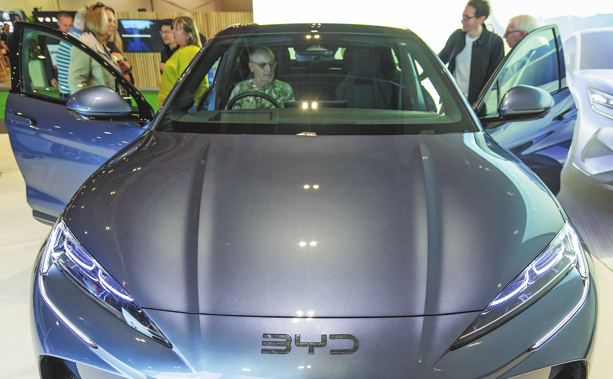
Earlier this month, Beijing and Brussels, after more than a year of talks, agreed to set minimum prices for imported Chinese electric vehicles in lieu of hefty tariffs.
Commerce Minister Wang Wentao has expressed hope that the Finnish government could play an active role in helping and encouraging the EU to exercise prudence in using trade and economic restrictive tools, during a meeting with Finnish Prime Minister Petteri Orpo earlier this week.
Orpo also stressed that Finland supports free trade and fair competition and looks forward to greater mutual trust and reduced trade barriers between Europe and China.
Driven by deep economic integration and complementary market needs, this reality makes managing friction while deepening collaboration not just an option but a necessity for both sides, senior executives said.











