


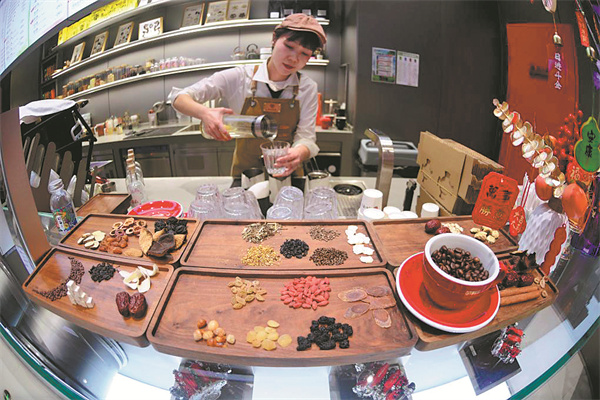
For generations, traditional Chinese medicine arrived with ceremony as dried roots and peels carefully measured from wooden drawers, taken home, and simmered in a slow, bitter ritual that demanded attention when the body called for care.
Today, it can be ordered iced and sipped while commuting.
On the iconic Chunxi Road, a century-old commercial area in Chengdu, Southwest China's Sichuan province, a cup of coffee is rewriting expectations. "At first sip, it tastes like coffee," says Shazia, a Pakistani student studying in China. "But the finishing note holds a hint of lemon, light and refreshing."
The drink is a dried tangerine peel and hawthorn Americano from Tong Ren Tang (Beijing TRT Group), a venerable TCM pharmacy with a heritage spanning over 350 years.
For foreigners, the encounter can be puzzling. Why are coffee, bread and new-style tea drinks in China increasingly infused with medicinal herbs? The answer reflects not a simple revival of traditional remedies, but a broader reordering of health, anxiety and everyday consumption.
Tong Ren Tang's foray into lifestyle retail is emblematic. Founded in 1669, it has been associated with orthodox medicine since the Qing Dynasty (1644-1911) and has expanded into lifestyle-oriented formats in recent years. Through its youth-oriented sub-brand, Zhima Health, it now sells coffee, tea drinks, baked goods, and bottled "wellness waters", weaving familiar herbal ingredients into consumption settings young consumers already frequent.
The menu sounds more culinary than clinical, with offerings such as a goji berry latte, a monk fruit Americano and a cinnamon cappuccino. These are not prescription drugs. In Chinese tradition, they belong to what is known as the "medicinal and edible homology" system, in which ingredients commonly used in cooking provide mild nourishment, aid digestion, reduce sugar intake, and help balance taste.





