



Consumption emerging as growth stabilizer









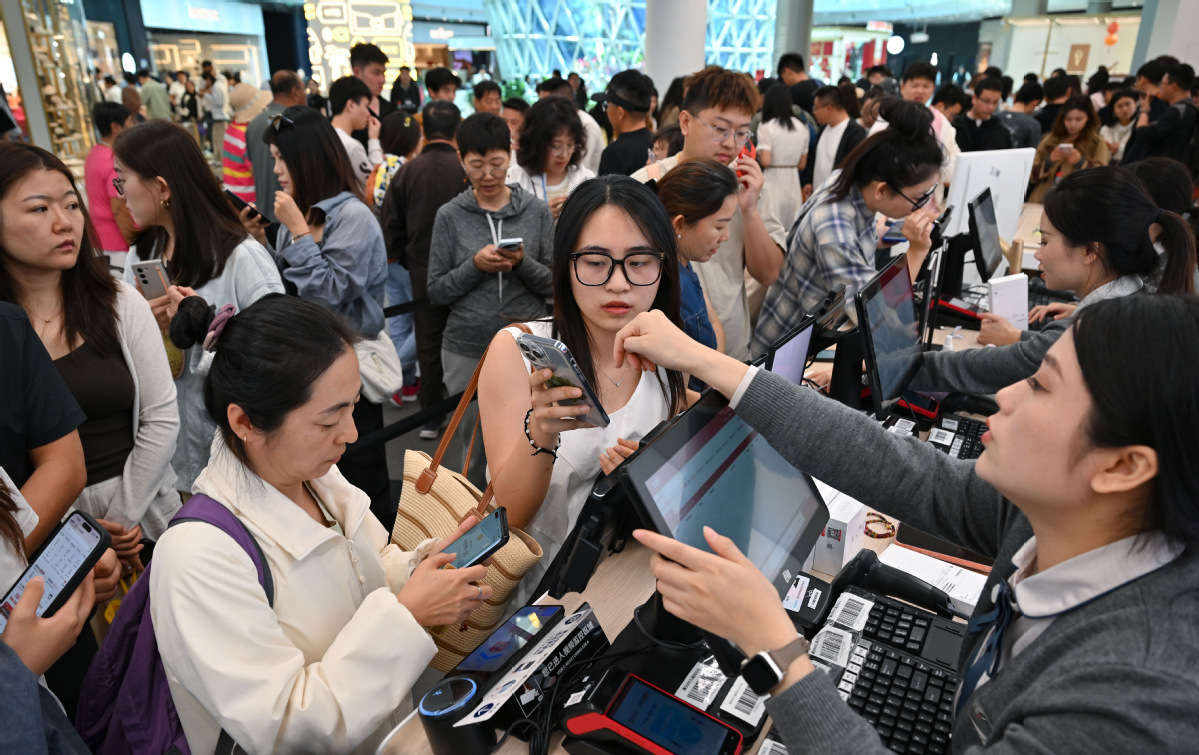
Just 20 days into 2026, China has rolled out an intensive array of consumption-boosting policies. Ranging from State subsidies and tax exemptions to trade-in programs and interest rate cuts, these measures are unleashing comprehensive dividends, invigorating the consumer market and driving a robust rally in the A-share consumption sector.
Amid a volatile international landscape and slowing global trade growth — China's total import and export volume grew by 2.1 percent year-on-year in 2025, a deceleration of 3.5 percentage points — external uncertainties are rising.
Domestically, the economy is at a critical juncture of transformation. With traditional engines like real estate and infrastructure decelerating, new growth drivers are urgently needed.
Consumption has emerged as the bedrock of the national economy. Its contribution to economic growth reached 44.5 percent in 2024 and climbed to 53.5 percent in the first three quarters of 2025.
The huge market serves as a stabilizer against external risks. The recent policy blitz aims to activate this endogenous power, ensuring the "consumption carriage" runs faster and steadier to counter external fluctuations with the certainty of internal circulation.
Since the beginning of the year, the consumption sector has become a standout performer in the A-share market. On Jan 16, related stocks such as Henghui Safety and Suzhou Electrical Apparatus Science Academy hit the daily limit, while others like Mengtian Home Group surged over 9 percent.
This performance reflects clear market expectations. Following the implementation of trade-in policies on Jan 4 and new service consumption measures on Jan 16, sectors from home appliances to tourism and elderly care have rallied. The clear policy trajectory provides solid support for the market's stabilization and recovery.
The Central Economic Work Conference has highlighted that domestic demand will remain as a focus in building a robust domestic market.
Li Zhiqi, vice-chairman of the Beijing Federation of Industry and Commerce, noted that the conference's deployments aim to enhance the quality of people's lives.
"Previously, boosting consumption was often an emergency measure. Now, shifting to domestic demand dominance implies a solid interaction mechanism between supply and demand," Li said. He emphasized that for the "main engine" of domestic demand to run effectively, three issues must be addressed: ensuring people dare to consume, can consume, and are willing to consume.
"When consumption brings emotional resonance and unique experiences, the willingness to consume is naturally ignited," Li added.
Data from the National Bureau of Statistics show that from January to November 2025, service retail sales increased by 5.4 percent year-on-year, outpacing goods retail sales by 1.3 percentage points.
"As policies to expand service consumption are implemented in detail, residents' consumption potential is continuously unleashed," said Yuan Yan, chief statistician of the NBS Department of Trade and External Economic Relations, highlighting the optimization of cultural and digital consumption supplies.
Hong Yong, an associate researcher at the Chinese Academy of International Trade and Economic Cooperation under the Ministry of Commerce, analyzed that the emphasis on "deepening the special action to boost consumption" signifies a shift from phased stimulation to systematic exertion.
By integrating policy tools across tourism, elderly care, and digital services, and simultaneously addressing supply-side expansion and demand-side burden reduction, the country aims to strengthen the endogenous power of resident consumption. This marks the elevation of service consumption from "shoring up weak spots" to a core agenda of macro-control and structural transformation, Hong said.








