



Forum stresses importance of opening-up
Experts say openness a necessity for sustaining high-quality development









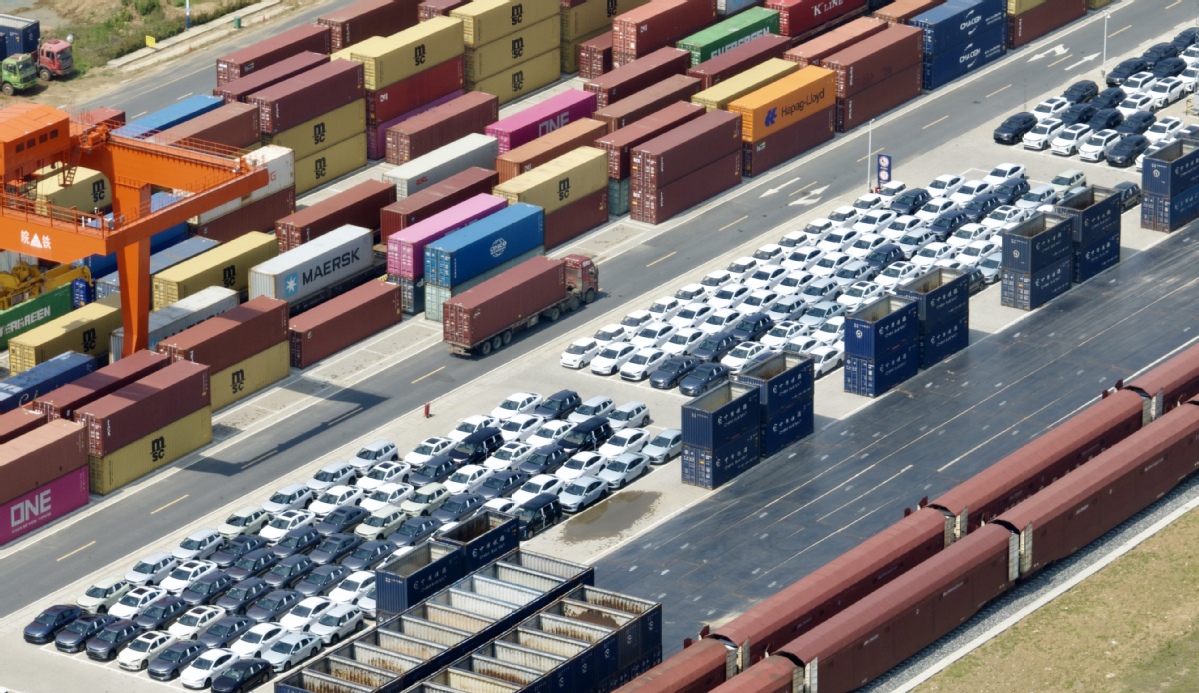
China is stepping up efforts to advance high-level opening-up and anchor growth in deeper reform, institutional alignment and trade innovation as a strategic response to a fragile global economy, rising protectionism and rapid technological change, said participants attending the Fourth Forum on the Development of Opening-up on Wednesday.
Against the backdrop of an accelerating global transformation marked by sluggish growth, geopolitical tensions and a reshaping of industrial and supply chains, they said openness is no longer a choice but a necessity for sustaining high-quality development and securing long-term competitiveness.
"Under profound global changes, openness is more important than ever," Jin Xu, chairman of the China Association of International Trade, told the forum held by the University of International Business and Economics in Beijing.
Jin said the global economy is facing mounting headwinds, including unilateralism and trade protectionism, while a new wave of technological and industrial revolutions — driven by digital technology and green transformation — is rapidly reshaping global industrial, supply and value chains.
"At the same time, global governance is undergoing deep adjustments, and the multilateral trading system with the WTO at its core is facing serious challenges," he said.
In this context, Jin said China's decision to pursue institutional opening-up as a driver of high-quality development is a strategic choice rather than a slogan, reflecting coordinated consideration of both domestic and international imperatives.
Going forward, Wang Xuekun, head of the Chinese Academy of International Trade and Economic Cooperation, said China should further align with high-standard international economic and trade rules, including those covering intellectual property protection, environmental and labor standards, government procurement, e-commerce and finance, while expanding market access in sectors such as telecommunications, the internet, education, culture and healthcare.
Wang said more efforts should be made to expand imports, promote balanced trade, strengthen services exports and gradually reduce constraints on digital trade, while moving from adapting to international rules to actively contributing to and shaping them. Wang added that "China should transform from a passive rules adapter into an active co-creator and leader of international economic and trade rules."
Zhao Zhongxiu, president of the University of International Business and Economics, said the rapid rise of global services trade presents a major opportunity for China's high-quality opening-up.
"Global services trade is growing faster than goods trade and overall economic growth. The share of services exports in global exports has risen from 20.4 percent in 2005 to 27 percent in 2024, and is expected to exceed 30 percent by 2040," Zhao said.
China's services trade has expanded from near zero to world-leading levels over the past few decades, with knowledge-intensive services accounting for more than half of total services exports, Zhao said.
Zhao acknowledged challenges, including gaps in openness, policy support and international influence, but said structural upgrading, consumption expansion, outbound investment and rapid technological progress are creating new momentum.











