


L3 autonomous driving takes to city streets
Beijing, Chongqing first urban areas to pilot cutting-edge technology










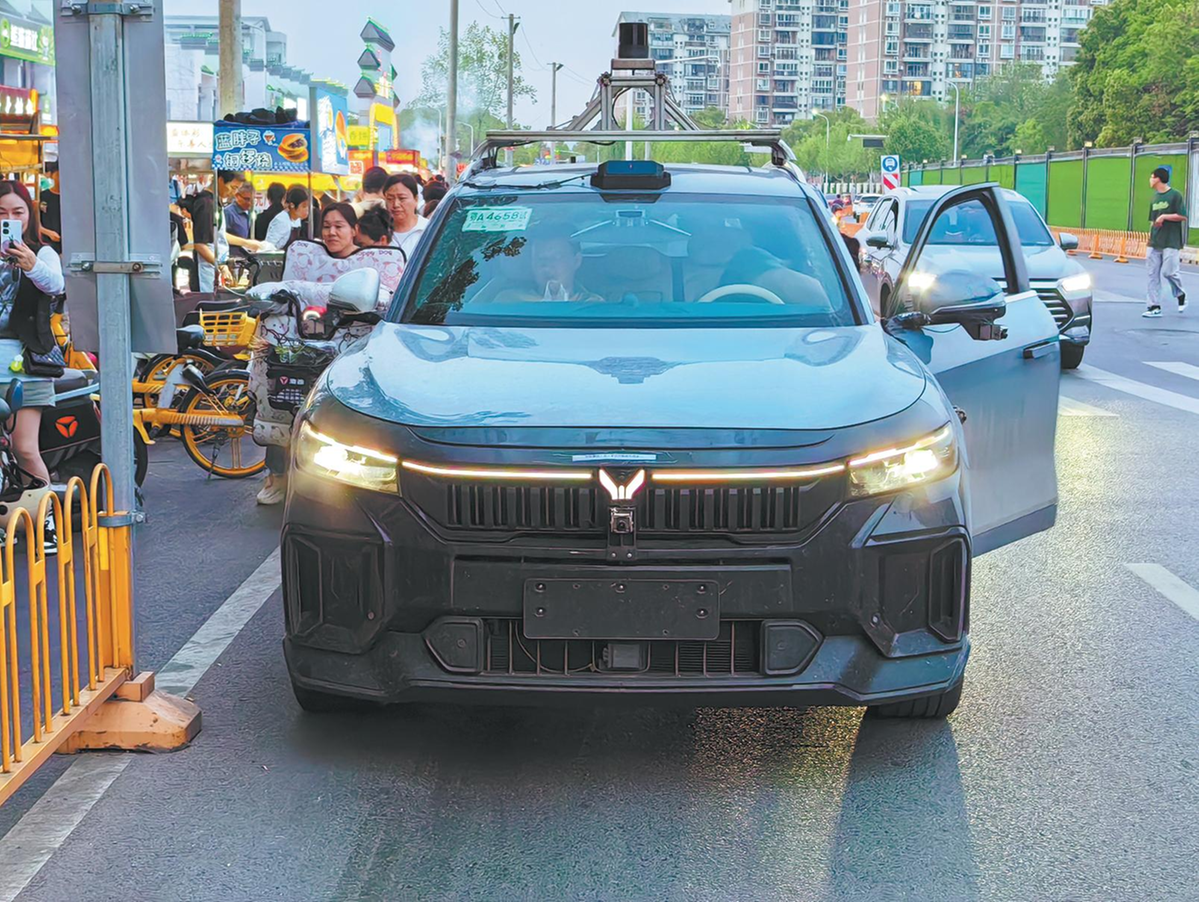
On the bustling roads of Beijing, a subtle revolution is taking shape, marked by a series of distinctive license plates. To the untrained eye, they are just alphanumeric codes. To China's intelligent vehicle industry, they are emblems of a historic leap. These are not ordinary plates but the nation's first official license plates issued specifically for level 3 conditional autonomous driving vehicles, symbolizing a formal transition from prolonged testing to regulated, on-road commercial piloting.
This tangible milestone follows the recent announcement from China's Ministry of Industry and Information Technology, granting the first-ever batch of market-access permits for L3 conditional self-driving vehicle models. Two models — one optimized for stop-and-go urban congestion, the other for structured highway driving — are now authorized for limited public use in designated areas of Beijing and Chongqing. This move decisively shifts L3 technology from closed proving grounds into the complex, unpredictable realm of real-world traffic interaction.
The approved models were developed by Changan Automobile and BAIC Motor's Arcfox brand.
Changan and BAIC are among a batch of joint groups in a pilot program for access approval and road testing of intelligent connected vehicles in China.
The pilot program was initiated as early as 2023 by several ministries, including MIIT and the Ministry of Transport, to accelerate the development of intelligent connected vehicles and boost local innovation.
Other participants in the pilot program include BYD, Nio, FAW Group and SAIC, according to sources.
The program is not limited to passenger vehicles. It also covers trucks and buses. Participating manufacturers include heavy-duty truckmaker SAIC Hongyan and Yutong Bus.
The core of L3, or "eyes-off, mind-on", automation lies in its conditional nature. Under specific operational design domains, such as certain highways or slow urban traffic, the system can take full control of dynamic driving tasks, legally allowing the driver to disengage. However, the human must remain ready to intervene when prompted. This phase fundamentally changes the relationship between human and machine, moving the industry's focus from perfecting "hands-off" technology to defining clear lines of "liability-on".
Sun Hang, chief engineer of the China Automotive Standardization Research Institute, said: "The approval of the first L3 models means that for the first time, China has allowed autonomous vehicles to enter the market as formal products at the policy level. We are exploring commercial application through pilots, which is a landmark in itself,"Sun said.
In China, driving automation is defined by six levels, from 0 to 5, with L0 meaning that such vehicles are entirely operated by humans. Levels 1 and 2 are considered driver-assistance systems, in which the human driver remains perpetually responsible for monitoring the environment and must be ready to intervene instantly, according to the MIIT.
Liu Fawang, deputy head of the ministry's Equipment Industry Development Center, said that L3, or "conditional automation", is the pivotal threshold. The vehicle itself can perform dynamic driving tasks such as steering, acceleration and braking under specific conditions, and the driver is not required to monitor the road continuously, but only to respond when the system requests intervention.
"The shift to L3 formally enters the realm of automated driving where the responsibility for the driving task can be allocated among the driver, the car manufacturer and the system supplier. This represents a monumental shift from the unequivocal driver liability associated with L1 and L2 cars," Liu added.
Fu Bingfeng, secretary-general of the China Association of Automobile Manufacturers, said: "The move means that China's autonomous vehicle sector is accelerating from the 'technical validation' phase into a new stage of 'mass production and application'. This progression is not merely a reflection of technological maturation, but also a vivid example of the nation's coordinated strategy to balance high-quality development with high-level safety."
Sun said: "The pilot is designed to better ensure the safety of drivers and passengers. It reflects an overarching philosophy of prioritizing safety and advancing step-by-step, starting with low-risk, limited-scenario trials before considering broader applications. While the full integration of autonomous driving into daily life still requires time, this step clearly indicates that autonomous driving technology is one step closer to us."





