


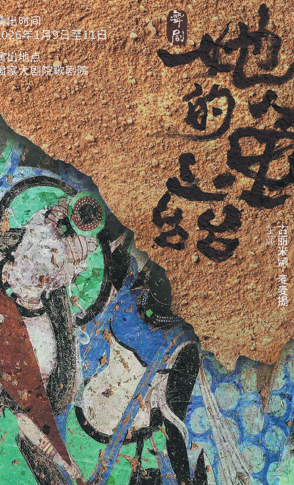
Many people may not know that a brilliant civilization once flourished along the Silk Road — the Kingdom of Qiuci (Kucha).
Qiuci, located in the west of today's Kucha county-level city in the Xinjiang Uygur autonomous region, was a key hub along the ancient Silk Road. It played a vital role in linking trade and cultural exchanges between the East and West. During the Han (202 BC-AD 220) and Tang (618-907) dynasties, the Central Plains governments established protectorates there, underscoring the region's strategic significance.
Shaped by a fusion of multiple cultures, Qiuci's music-and-dance tradition and mural art are especially renowned.
Its elegant dances captivated audiences across Asia. But as the civilization declined, later generations could glimpse its splendor only through surviving murals. Today, the ancient dance of Qiuci is returning to the public.
A news conference was held in Beijing on Dec 11 for the dance drama Her Qiuci, produced and performed by the Minzu University of China's College of Dance. The production tells the story of a modern female mural conservator who, while restoring Qiuci wall paintings, is transported back in time. She sees both the ancient kingdom's glory and the devastation wrought when Qiuci's murals were looted.
The dance drama will be staged for three consecutive performances at the National Centre for the Performing Arts from Jan 9 to 11.
In Qiuci music and dance, musical instruments were not only played but also used as props. Merging Eastern grace with Western dynamism, the art form reached its peak during the Tang Dynasty and influenced regions such as ancient Japan and the Korean Peninsula.
This legacy is preserved in the Qiuci Grottoes murals, where dance scenes appear alongside Buddhist stories. However, extensive looting by foreign expeditions in the late 19th and early 20th centuries left many murals scattered in overseas museums, while the remaining grottoes suffered severe damage, complicating modern conservation efforts.
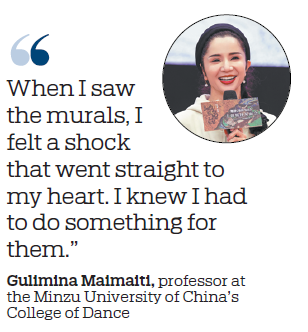
Gulimina Maimaiti, a professor at the Minzu University of China's College of Dance, is the producer and lead performer of Her Qiuci, portraying a mural conservator. She says the inspiration for the work came from her field research in Kucha, where she observed conservators at work.
"The conservator worked alone day after day, staring at the murals and painting them bit by bit. Three full years were devoted to restoring a single work."
From its initial concept to its current staging, Her Qiuci has taken five years to complete. During this period, the creative team made repeated field trips to the Qiuci Grottoes, conducting in-depth studies of the dance postures, costumes, and musical instruments depicted in the murals.
Maimaiti remembers her first visit in 2021 vividly: "When I saw the murals, I felt a shock that went straight to my heart. I knew I had to do something for them."Earlier this year, she and her team released a short Qiuci dance video online, sparking public debate and garnering over 100 million views across platforms.
The dance drama continues her promise to bring the murals' stories to life. As a Xinjiang native, she adds that the work is a deeply personal expression of love for her homeland.





