


Solar shelters shrubs to stunt Inner Mongolia's shifting sands
Integrated soil restoration pilot project gains ground in China's rugged north










Restoring greenery
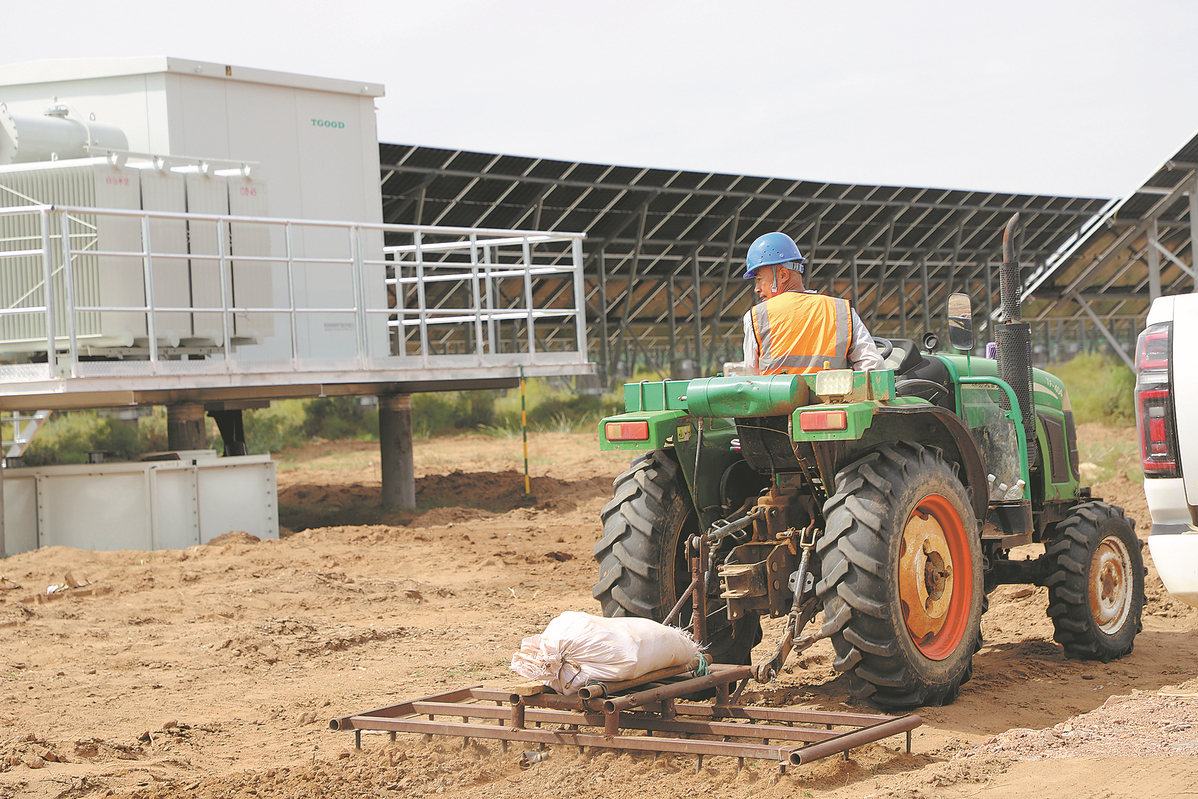
Last year, the banner launched China's first pilot project integrating grassland restoration with solar power generation, using panels to physically block sand and wind, and provide shelter while generating clean energy.
Due to its unique geography, Inner Mongolia acts as a key ecological barrier for the country, so the success of the pilot project could lead to this approach being rolled out in areas with similar challenges.
Zhou Hui, director of the forest and grassland resources protection center at the banner's forestry and grassland bureau, said that from the 1980s onwards, overgrazing and climate change-induced drought had taken a heavy toll on the grassland.
High-quality pasture has been repeatedly grazed to the point where it can no longer recover, while soil erosion and shrinking surface water bodies have further accelerated the degradation, he said.
"Animal husbandry suffered severe setbacks as grass yields declined sharply," Zhou said. "As a result, herders' incomes dropped, and more than 20 percent of households fell into poverty."
The ecological decline forced many herders to leave and hindered regional development, he added.
To reverse the trend and revitalize the animal husbandry industry, the local government has mobilized enterprises and herders to join the restoration efforts. In addition to the solar shelter project, traditional restoration measures, such as artificial reseeding and rainfall enhancement, have been introduced in the area.
Thanks to the banner's 3,000 hours of sunshine each year, the concept of "power generation above, restoration below", was introduced last year.
"We conducted ecological adaptability assessments to identify shade and drought-tolerant grasses such as alfalfa and crested wheatgrass,"Zhou said. "We needed species that could thrive in the shaded microclimate beneath the panels."
To accommodate grass growth under the panels, they were set at a minimum height of 2.5 meters above the ground and with a row spacing of 6.5 meters. The height is significantly higher than the common 0.8-to 1-meter height used in typical photovoltaic projects.
"This design ensures efficient power generation while providing enough space and sunlight for the grass below," Zhou said.
Once panel installation had been completed, workers sowed the seeds. Months later, verdant growth blanketed the area beneath the panels.





