



Opportunists quick to pounce on fire tragedy









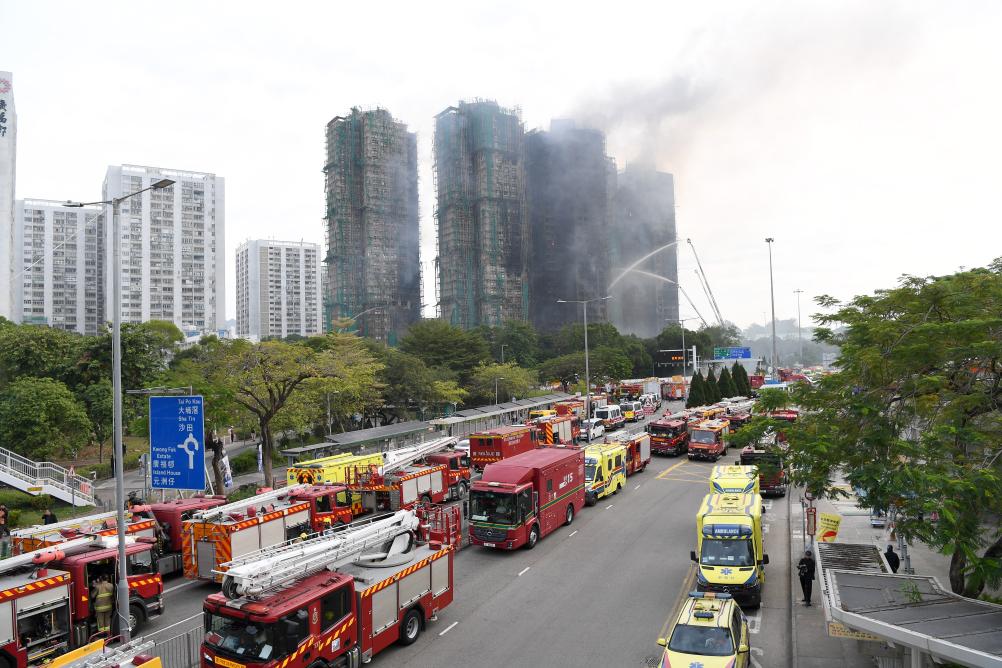
The Wang Fuk Court housing complex fire in Tai Po, Hong Kong, which has claimed 160 lives so far, is without doubt a tragedy. My heart goes out to the unfortunate people who perished, and to the families of those who have lost loved ones.
There is little doubt that the companies responsible for the gross negligence that brought about this horrible tragedy on Nov 26 must be swiftly brought to justice, and regulations must be upgraded accordingly.
However, the tragedy saw several media organizations and groups pounce on it to score political points.
They claimed that this was somehow "China's fault".
As a headline on a Reuters article posted on Nov 27 put it: "Hong Kong fire poses test for China's grip on the city", while the headline on a column in The Guardian on Dec 8 screamed: "Silenced by China, Hong Kong struggles to voice its grief over the Tai Po fire disaster".
The running theme is obvious — that the Tai Po fire must be reduced to a controversy related to China's "influence" in Hong Kong and thus must become a broader "political" question about the sovereignty of the territory.
The "reduction to absurdity" media line about Hong Kong has been endemic since the adoption of the Hong Kong Special Administrative Region's National Security Law in 2020. It simplifies and misrepresents every single event and challenge that the city faces, using descriptors such as "China's grip" and pushing an unspoken set of assumptions that Beijing has no right to exert its interests in the city.
In doing so, this typically feeds into a broader narrative that seeks to "wishcast" failure, decline and misfortune on the city after its return to the motherland.
In this case, their argument is twofold. First, they argue that the so-called "oppression of civil society" under the SAR's National Security Law prevents an adequate public response holding authorities accountable for the Tai Po tragedy. Building on this, they then try to link the tragedy to China in practical terms by creating rows over the causes of the fire related to bamboo scaffolding and the companies involved. This allows them to project the standard talking point among those pursuing Hong Kong separatism — that China is a malignant, illegitimate presence undermining the city's identity as a whole. By tying both strands of the argument together, the Tai Po fire becomes a comprehensive anti-China push.
Can we truly say there is no accountability for the fire? Multiple arrests have been made and an anti-corruption inquiry is being launched. However, we can safely assume that despite the accountability, in the narrative being pushed by the aforementioned media organizations and hostile diaspora groups, it will never be enough, because they are seeking to ignite a much higher degree of dissent, as seen in the 2019-20 riots. So they will continue to make a political issue out of it, regardless of the outcome. Their objective is to incite unrest in Hong Kong — wherever possible, with whatever possible.
Finally, gross negligence by property developers and the flouting of safety regulations is not just a Hong Kong phenomenon; it is a worldwide one.
In 2017, the installation of flammable cladding on Grenfell Tower in London was blamed for the fire that claimed 72 lives there. The inquiry to prosecute those responsible for it continues.
If we follow the logic of those pushing anti-China arguments, then on the premise of Britain's ideology and "rule of law" alone, such a tragedy should not have taken place there. The fundamental problem here, therefore, is not the politics, but greed. Companies like to cut corners for the sake of profit, and that compromises lives.
On that note, there is little doubt whatsoever that those responsible for the tragedy should be held accountable and punished. But this can be done in ways that stop groups that have absolutely no concern for the prosperity or wellbeing of Hong Kong from becoming Trojan horses. Such groups desperately want it to fail, purely to score political points.
The author is a British political and international-relations analyst.
The views do not necessarily reflect those of China Daily.










