



An exclusive interview with 'Napoleon' in Waterloo









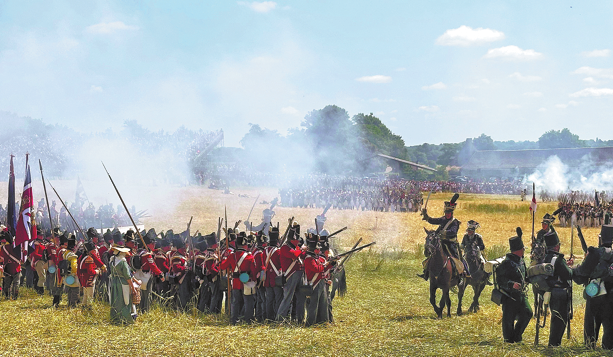
It began with thunderous blasts. In the heat of noon, the first cannon blast tore open the calm Belgian sky, its shockwave hitting my chest before my ears fully understood the sound. Ten meters away, a shell exploded, throwing dirt into the air and drowning thought in the roar of battle. For a moment, there was only the clatter of metal and frantic shouts by officers giving commands.
As the smoke cleared, the combatants emerged: lines of red-coated infantry with muskets leveled in perfect alignment, and from the opposite direction, deep-blue columns marching to the rhythm of drums and brass, hailing in French. Gunfire cracked in volleys, cannonballs split the earth, and men fell as they were hit by bullets. Neither side gave ground.

This was Waterloo — not 1815, but today — staged on the very ground where history changed course. To mark the 210th anniversary, organizers recruited 2,200 performers, 100 horses, 25 cannons and 1.3 metric tons of gunpowder — a year's preparation condensed into a spectacle aiming to entertain and revive history.
Just as the mock battle seemed to stall, the "Prussians" arrived, wearing uniforms nearly identical to the French. This time, though, the lookalikes supported the opposite side, dressed in lobster uniforms. Their sudden flank attack broke the French lines, and the coalition forces of Britain, Prussia and the Netherlands erupted into cheers.
Two centuries after his fall, Napoleon Bonaparte was defeated once again by a united Europe.
After the performance, the commanders rode a victory lap. Yet, the loudest cheers were not for the Duke of Wellington or Marshal Blucher. Instead, the crowd roared for the man playing Napoleon, riding a white horse, radiating dignity even in scripted failure.
I chased the white horse to a camp behind the field, where tents stood amid reenactors wiping off artificial grime. There I found the man at the center of Europe's applause: Mark Schneider, the actor playing Napoleon. A United States citizen with French and German roots, he carries a fitting lineage for someone embodying one of Europe's most debated figures.
"A loser can be a hero," he said before I finished my first question. "Every one of us fails in the end. We all leave the world one day. What matters is whether we fought, whether we lived something worth remembering. That struggle is what people admire."
To prepare, he devoured biographies of the emperor. Napoleon's popularity today has little to do with imperial might, and many people see him not as a distant ruler but a relatable underdog.
"He was not even born truly French," Schneider said. Napoleon came from Corsica, a rough island newly annexed by France. He spoke awkward French at school, was small in stature, hardly a natural fit for a military world built on physical bravery — yet he almost conquered Europe.
In modern terms, Napoleon was remembered not as an emperor but as the ultimate self-made figure — a protagonist mocked for his accent and size who emerges from nowhere to rewrite the fate of a continent.
That's why the crowd cheered as the defeated emperor rode past — they were not saluting the ruler, but honoring the little Corsican who climbed higher than anyone expected.
A legend's peak is enough. The inevitable fall cannot erase it.
Another reason lies in Europe's history, which crosses borders just as armies once did. Decades of integration have softened national lines and many now identify less as French or German but more as Europeans.
The reenactment was a living proof. Soldiers in British red coats turned out to be Spanish, Argentine, even Mexican. The "French" side included Belgians and Italians. Actors chose uniforms not by nationality but by interest in the role.
"We do this to remember one of the most important days in Europe's story," said director Thibault Danthine. "What happened here changed the direction of our continent and brought us a century of relative peace."
The reenactment was not designed to romanticize the past but to keep its warning alive so that Europe would never repeat it, Danthine said.
Spectators I met shared a similar sentiment — Europe has been peaceful for so long that war feels distant, almost fictional, like a video game. The reenactment forced them to feel something real — the thud of cannon fire underfoot, the sting of powder in the throat, the suffocating smoke. It reminded them that war is not a strategic puzzle but a choking, deafening chaos where bodies fall in the mud.
No one died today in Waterloo, but the fear, disorder and noise were enough to make the point.
Before leaving, I wandered to the garden behind the Waterloo Memorial. There stands a statue of two soldiers in combat. Beneath it, leaning against a wall, sat a reenactor still in partial uniform. He had removed his heavy coat and rested in the shade, speaking excitedly into his phone in a language I couldn't place — Slovak, Basque, perhaps something rarer.
That moment felt like Waterloo's greatest lesson: Struggle and tranquility are never far apart. We remember violence to safeguard its opposite.
If this scene deserves a title, I would call it War and Peace.
The author is chief correspondent at China Daily EU Bureau based in Brussels.
Contact the writer at zhangzhouxiang@chinadaily.com.cn










