



ByteDance tweaks Doubao assistant amid app curbs









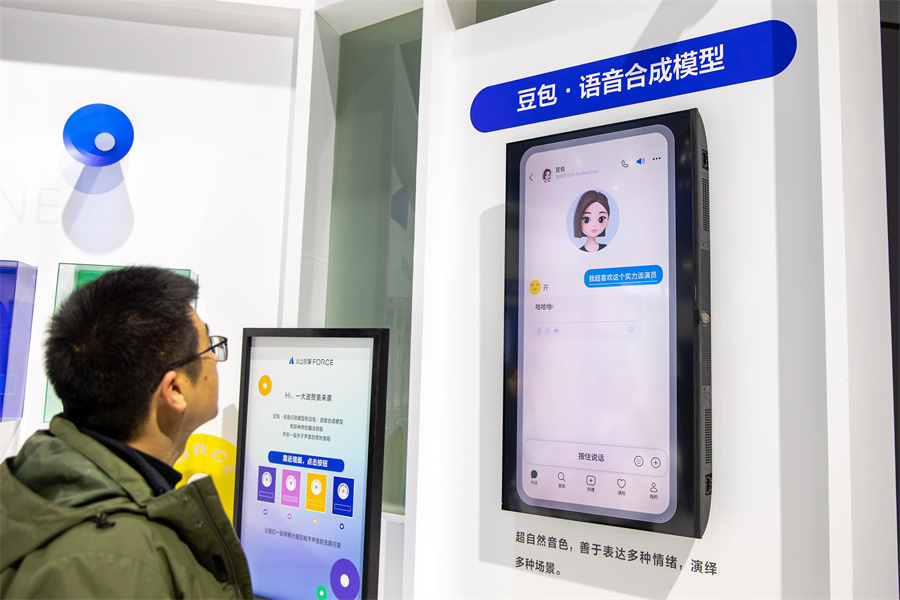
Chinese tech giant ByteDance said its artificial intelligence-powered Doubao mobile phone assistant will have some AI capabilities adjusted, while calling for protecting users' lawful rights to leverage AI as part of a broader push to balance technological advancements, industry acceptance and user experience.
The adjustment comes after several of the country's most widely used apps restricted Doubao's AI-enabled voice assistant functions.
The company said in a statement on Friday that it will make standardized adjustments to the abilities of the AI assistant for smartphones in certain scenarios over the coming period, highlighting that it will actively communicate with all parties to help establish clearer and more predictable rules, and avoid using a one-size-fits-all approach that denies users' legitimate rights to use AI.
The adjustments mainly involve restricting automated operations in various apps that are used to boost points or rewards, further limiting AI operational capacities in banking, online payments and other financial applications, and suspending AI use in certain competitive gaming scenarios to ensure fairness.
A new smartphone, which is equipped with an AI assistant powered by the Doubao large language model, has recently attracted widespread attention.
Nubia M153, an engineering prototype launched by smartphone maker ZTE last week, allows users to order takeout, book tickets, compare prices while shopping and even reply to WeChat messages or operate mini-program games via voice commands.
The assistant is an exploration of the deep integration between AI technology and smartphone systems. ByteDance said it has no plans to develop its own smartphones and is in talks with multiple phone makers to roll out the AI voice assistant.
Experts said the launch of ByteDance's AI assistant reflects the growing competition among tech companies to dominate AI-powered mobile phone technology, highlighting China's rapid adoption of AI in consumer electronic devices.
After the official launch, several users reported on social media that when using Doubao's AI assistant feature through some third-party apps, such as WeChat, they were prevented from logging in or their accounts were frozen on some apps. Some users also encountered pop-up warnings from banking apps that required them to close the AI assistant before proceeding.
Lyu Peng, associate dean of the Wuhan Institute for Artificial Intelligence at Peking University, said AI assistants could act as "messengers and coordinators" across various apps and represent the future development trend of AI technology, bringing about great convenience and improving operational efficiency.
At present, there is an urgent need to develop a protocol ecosystem and linkage mechanisms between AI assistants and various apps, he said, adding that it is essential to ensure that technology always "serves humanity", rather than restricting or depriving people's legitimate rights and opportunities to use new technologies to work more efficiently and improve their quality of life.
Market observers said the essence of the event is "a game between AI assistants and app developers".
Liu Xiaochun, an associate professor from the School of Law at the University of Chinese Academy of Social Sciences, said with users' explicit authorization and on the premise that personal information processing complies with relevant regulations, AI accessing third-party applications on behalf of the user is a lawful expression of the users' intent.
"The AI agent industry is still in its early stages, with both technology and regulations under exploration. For innovative technologies, a tolerant and prudent approach is needed, precisely regulating risks while leaving room for innovation to support their healthy development," Liu said.
Zhong Xiaolei, an analyst of market research company Omdia, said despite smartphone manufacturers showing openness in integrating different large language models, fragmentation in the AI ecosystem still persists, and mechanisms for information sharing between AI models and applications are still not fully established.
fanfeifei@chinadaily.com.cn











