



More Sino-EU cooperation to boost trade
Brussels encouraged to adopt flexible approach to stabilize relations









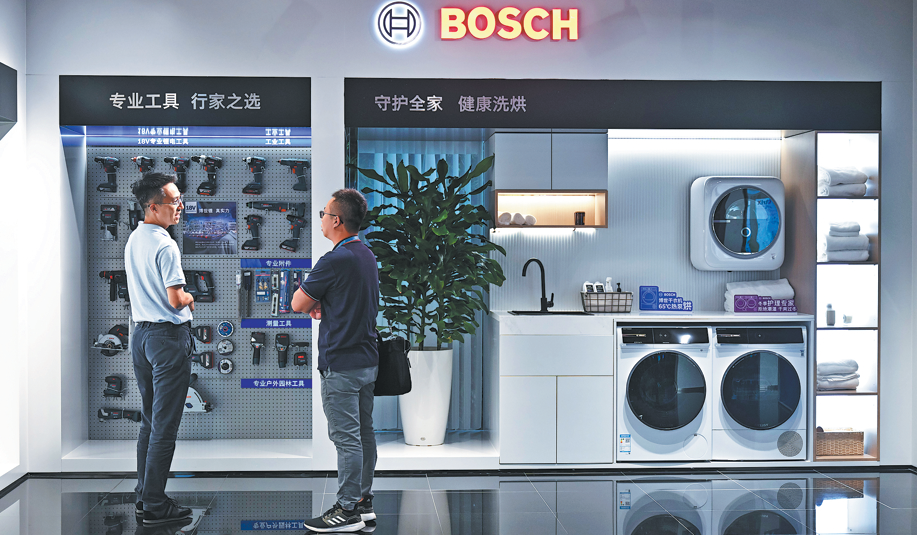
The European Union's unilateral and protectionist trade measures against China are fragmenting supply chains, raising costs and creating significant uncertainty for multinational corporations, particularly those within the bloc, experts and executives said.
Brussels should adopt a more cooperative approach with Beijing to help stabilize bilateral trade relations, they said, warning that rising protectionism would risk further escalating trade tensions and ultimately harm the EU's own interests.
A survey released on Monday by the European Union Chamber of Commerce in China showed that a majority of respondents had already been — or expected to be — impacted by China's export control measures.
"China's export controls have increased the uncertainty felt by European businesses operating in the country, with companies facing risks of production slowdowns or even stoppages," said Jens Eskelund, president of the European Union Chamber of Commerce in China.
Once all of China's announced export control measures have been implemented, 60 percent of respondents expect "moderate" or "significant" disruptions to their supply chains. An additional 13 percent expect to face production stoppages or slowdowns, according to the survey.
The countermeasures adopted by Beijing are a response to the bloc's resorting to unilateral trade instruments in a more aggressive way toward China, including hefty tariffs on Chinese-made electric vehicles and steel, and restrictions on Chinese medical devices in its public procurement market.
"Global industries, from automobiles to semiconductors, are deeply intertwined. Disrupting that web doesn't just hurt China — it impacts production, innovation and inflation for Europe as well," said Cui Fan, a professor of international trade at the University of International Business and Economics in Beijing.
Although 43 percent of respondents have yet to decide how to respond to China's export controls, 36 percent intend to work with suppliers to develop more capacity outside of the country, the survey showed.
"Further escalation between China and the EU would only destabilize the ties that support consumer markets and corporate growth within the bloc," said Zhou Mi, senior researcher at the Chinese Academy of International Trade and Economic Cooperation.
Zhou noted that the EU's strengths in advanced technology and high-end manufacturing find one of their most significant applications and scaling opportunities within China. Meanwhile, China's industrial ecosystem and market scale provide European companies with supply chain resilience and growth potential.
The ability of businesses to thrive depends on the overall stability and predictability of the economic environment, which could be enhanced through closer China-EU cooperation rather than trade barriers and restrictive measures, Zhou added.
Yin Zheng, executive vice-president of China and East Asia operations at Schneider Electric, said that China serves as a vital engine for global economic growth, supported by a robust industrial foundation and a resilient supply chain.
In particular, the advancement of new quality productive forces — which emphasizes digital and green factors as core components of production — provides a broader development platform for foreign tech firms.
"Investing more in China means investing in the future," Yin said, adding that China has become the French company's second-largest market worldwide, and one of its four major global research and development hubs.
wangkeju@chinadaily.com.cn








