



French govt collapses in historic vote
Bayrou's loss puts country in crisis, indicating rift in lower house










The French government has collapsed in a stunning vote, marking a historic first for the country's modern political system.
In a confidence vote on Monday, Prime Minister Francois Bayrou's administration was toppled by a decisive margin of 364 votes to 194.This is the first time in the history of the Fifth Republic, the current French political system that a government has been brought down in this way.
The defeat has thrown the nation into a deep political crisis, with less than two years remaining in President Emmanuel Macron's second term.
Having been appointed in December 2024, Bayrou's government was struggling to manage France's growing national debt.
He sought the confidence vote in an attempt to get his controversial budget plans passed, but the attempt failed, highlighting the deep and persistent divisions within the National Assembly, the lower house of the French Parliament.
After the vote, Bayrou acknowledged his government's demise. "It was a time of deep happiness," he said in parliament, thanking his ministers before leaving the parliament building.
Increasing instability
Bayrou officially submitted his resignation to President Macron on Tuesday, according to the government website. The president now needs to name a new prime minister, who will be responsible for forming a new government. This is the fourth government to fall under Macron's second term, a sign of the increasing political instability in France.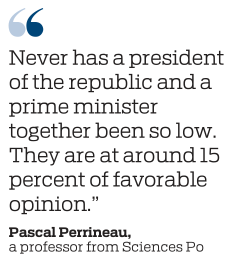
The instability has also been felt on the streets. A protest movement called "Block Everything", which started online a few months ago, was planning a nationwide strike on Wednesday. The group aims to bring France to a standstill to protest the government's economic policies. Trade unions have also announced their own separate protest for Sept 18.
"This is the last card," a lawmaker from the political center lamented, adding, "A dissolution of Parliament will happen if the new prime minister fails."
Macron now faces a difficult and crucial decision. He has two main choices.
The first is to appoint a new prime minister without delay. This person would need to secure a majority in the highly divided National Assembly to avoid the same fate as his predecessors. A coalition government with various opposition parties could be formed, including the Socialists. However, this is a "tortuous path", according to Julien Boudon, a professor of public law who spoke to the French daily newspaper Le Monde on Tuesday. He explained that it would require significant compromise. Otherwise, the president can appoint a prime minister who leads a minority government, which would constantly have to negotiate with other parties to pass laws.
The other choice is to dissolve the National Assembly and call for new parliamentary elections. This would be a risky move for President Macron, as there is no guarantee that his party would win a majority. The far-right National Rally is the only major party openly pushing for new elections, hoping to increase its number of seats in Parliament and secure a majority.
Difficult position
Political commentators have pointed out the difficult position Macron is in.
"Never has a president of the republic and a prime minister together been so low. They are at around 15 percent of favorable opinion," said Pascal Perrineau, a professor from Sciences Po, on French radio station RTL on Monday.
One of the main possibilities being discussed is a "cohabitation government". This is a special situation in the French political system where the president and the prime minister come from different political parties. It happens when the president's party does not hold a majority in the National Assembly.
In such a scenario, the president's power over domestic policy is limited, and the prime minister, who is chosen from the opposition, takes the lead on internal affairs. The president's main responsibility then becomes foreign policy and defense.
While a Socialist prime minister is an option, it is considered unlikely. Political analyst Jerome Jaffre noted on France Inter radio that "asking the opposition to support the government and to be part of its camp is an absolute political nonsense".
Meanwhile, Jean-Philippe Tanguy, a lawmaker from National Rally, stated on radio station RMC before the vote that bringing down a government "is without a doubt sometimes the best solution". The coming days will be critical, as France waits to see what President Macron decides during this unprecedented crisis.
The writer is a freelance journalist for China Daily.


Today's Top News
- 20th CPC Central Committee starts fifth plenary session
- An innovative future for Global South
- Letters from Long March a legacy of faith and perseverance
- Proposed US investment curbs slammed
- One-China principle emphasized
- Xi, Belgian king mark 55 years of diplomatic relations





