



Contesting claims across South China Sea 'not to impact overall relations'









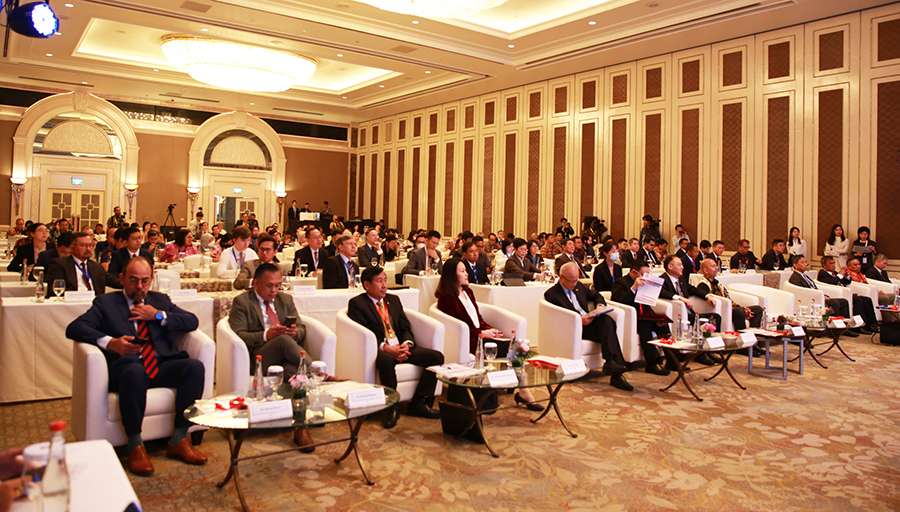
Tensions over the South China Sea is not an issue between China and the Association of Southeast Asian Nations (ASEAN) as a group, a senior Chinese diplomat said.
"That is very clear," Cui Tiankai, former Chinese vice minister of foreign affairs and ambassador to the United States, told reporters on the sidelines of the Jakarta Forum on ASEAN-China Relations on June 22.
China and some ASEAN members such as the Philippines have contesting claims over the strategic waterway. Cui said that despite these territorial disputes, China and ASEAN members "still develop and manage our overall relations very constructively for mutual benefit".
Cui was at the forum held to mark the 20th anniversary of China's accession to the Treaty of Amity and Cooperation in Southeast Asia, or TAC.
The TAC, launched in 1976, aims to uphold the principles of peaceful coexistence and friendly cooperation among ASEAN members. China officially acceded to the TAC on Oct 8, 2003, becoming the first among major countries to join the TAC and to establish a strategic partnership with ASEAN.
Hou Yanqi, the Chinese ambassador to ASEAN, said it is "even more crucial to carry forward the spirit of the TAC today", noting that the region faces security and development challenges.
In her closing remarks at the Jakarta Forum, Hou said the region should adhere to openness rather than isolation; solidarity rather than division; and cooperation rather than confrontation.
"We should firmly support ASEAN community building and its greater role in regional and international affairs instead of treating us as an arena for major power rivalry or forcing ASEAN to take sides," she said.
Cui said the TAC has given its signatories a framework for addressing any possible disputes among them.
"We have been the first to do (things) for our mutual benefits, not only for the benefit of China but also for the common interest of China and ASEAN countries," he said, adding that China will be very happy to continue doing so.
Cui said TAC upholds the principles of mutual respect and non-interference in each other's internal affairs, which are aligned with the purpose and principles of the United Nations Charter and the spirit of the 1955 Bandung Conference.
He was alluding to the First Asian-African Conference, better known as the Bandung Conference, which was held in Bandung, the capital city of the Indonesian province of West Java.
The historic event brought together leaders of 29 Asian and African states to promote economic and cultural cooperation and oppose neocolonialism. The conference would later lead to the establishment of the Non-Aligned Movement in 1961.
Meanwhile, Cui also commented on the US plan to de-risk from China, saying that the "real risk is the policy. It is not China. They try to alter, even cut off the supply chain. This is very much against the logic of the economy; the logic of the market. This is in fact against their preaching over the years."
Cui said the US has "told us that we have to respect the free market, but now they are trying to change everything. I don't think that would work. I don't think it will serve their own interests. It would certainly hurt the normal function of the market."










