



In hard times, Lebanese turn to canine friends to help ease the gloom









BEIRUT-Hanan Awwad, a university student from southern Lebanon, finds moments of relaxation each day when she walks her dog in the evening along the Hasbani highway.
Her dog is a loyal companion who "shares my joy and sadness", said Awwad, adding that she is attentive to the health and comfort of her canine friend.
"We share our food with him in addition to his special food which is mainly imported," she said.
Despite the unprecedented financial crisis, people walking their dogs has become a common scene in Lebanese cities and villages.
With the unabated jobless rate, the collapse of the local currency and shrinking incomes, a segment of the Lebanese population decided to forget this bitter reality by spending sums of money caring for their pets.
Lebanese psychologist Jouhaina Daher said people tend to keep pet dogs when they want to escape from painful reality and alleviate their pain.
In the same vein, pet training centers, vet clinics, and stores selling dog food, clothes and toys are mushrooming in southeastern Lebanon.
Veterinarian Jalal Chamoun said he is surprised at this phenomenon in a country compounded with crises. "I have more than 25 dog owners daily asking for comprehensive veterinary examinations," Chamoun said in his clinic in the southern city of Nabatieh.
Chamoun charges 75,000 Lebanese pounds ($49.40) for the dog examination, while vaccines are priced at 200,000 to 500,000 pounds according to their quality.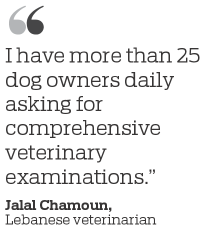
He also charges between 25,000 and 50,000 pounds for grooming services, based on the local currency's black market rate.
Faten Hmeidan, a young woman who had spent around $50 to $75 on dog toothpaste and accessories, conceded the cost of owning a dog is too high, but she is unable to give him up.
"I consider him a member of my family now," she said.
Statistics from the Lebanese Veterinary Medical Syndicate reveal that 15 percent of the Lebanese population keep dogs, Chamoun said.
Reducing costs
To help reduce the cost of owning a dog, a veterinary medical team working with the United Nations Interim Force in Lebanon offers periodic examinations, lab tests, vaccinations and free medication to help local farmers and pet dog owners reduce costs.
"Around 500 dogs get tested by this team, which reduces about 50 percent of the cost for citizens," said Chandan Singh, head of the vet team.
Ihab Munzer, a Lebanese man in his 20s, said he takes $70 out of the $300 he receives each month from his brother who works in the Gulf to buy food, clothes, vaccines and deworming pills for his dog.
"We feel great affection for him," he said.
Xinhua


Today's Top News
- Japan urged to fulfill nuclear non-proliferation obligations
- Lessons of Japanese militarism's aggression must forever serve as alarm: spokesman
- China unveils comprehensive geological map of the Moon
- Philippines' baseline claims riddled with legal holes
- Bruce Lee's enduring legacy of adaptability
- Dancing to the rhythm of culture and tradition





