



Youths urged to do more in AIDS fight









Top UN official sounds rallying call to students in Beijing
Young Chinese people need to do more to protect themselves from HIV/AIDS, a senior United Nations official says.
Michel Sidibe, UN under-secretary-general and the executive director of UNAIDS, says the world must do more to protect all adolescents and young people from AIDS.
| Michel Sidibe says more adolescents die every year from AIDS-related illnesses globally than from anything else other than road accidents. Provided to China Daily |
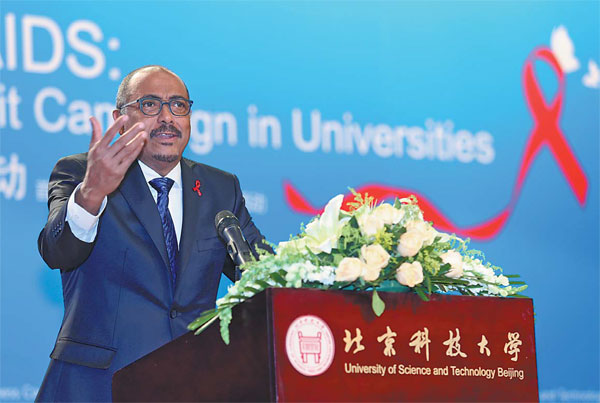
He made the comments in an address to students of the University of Science and Technology Beijing on May 4, China Youth Day. He was attending an event at the university called Toward Zero AIDS: Youth Social Benefit Campaign.
"We want to empower you to protect yourselves, your health and each other," Sidibe said. "In fact, we cannot end the epidemic without a global movement to end AIDS-related deaths and new HIV infections among adolescents."
The event was sponsored by the China-Africa Business Council and a public welfare fund called Increasing Love for Decreasing AIDS run by the China Social Assistance Foundation, and was jointly organized by the university and the Beijing Federation of University Societies and supported by UNAIDS.
Representatives of 60 universities in China, including more than 400 teachers and students, attended the event.
Sidibe said the ambitious goal of bringing the scourge of HIV/AIDS to an end is the centerpiece of a new program named All In For Youth Action to end Adolescent AIDS, which concentrates on areas in which the UN says it needs to make more progress, including improving data, identifying young people the program is failing to connect with and providing a sharper focus on adolescents in national AIDS programs.
The program also calls for new technologies and approaches to engage adolescents more effectively in advocating for more resources to reach every adolescent living with HIV or at risk of contracting HIV.
"All is about taking action before it is too late," Sidibe said. "The world cannot afford to lose you as future leaders who will bring progress to your communities and countries. We need you to be all in to end adolescent AIDS. The more we work hand in hand with you and support your leadership, the more successful our common efforts will be to end this epidemic together."
UNAIDS says about 35 million live with HIV. In 2013, 2.1 million people were newly infected, and 1.5 million people died of AIDS-related illnesses. Although access to HIV treatment has more than tripled over the past seven years, life-saving antiretroviral medicines are still out of reach for more than 22 million people worldwide in urgent need.
Young people are usually less vulnerable and more resilient to disease, but HIV has changed everything, Sidibe said. More adolescents die every year from AIDS-related illnesses globally than from anything else other than road accidents. Worldwide, 120,000 adolescents with HIV died in 2013, more than 300 every day.
"At a time when AIDS-related deaths have dropped dramatically in every other age group, it is disturbing that the death rate among adolescents is not decreasing," Sidibe said. "And it is shameful that this is happening when we have the knowledge and tools to prevent new HIV infections and, with treatment, effectively keep every adolescent living with HIV alive and well."
About 80 percent of those who died of AIDS-related illnesses in 2013 acquired HIV during their mothers' pregnancy or delivery or during the first months of life, he said. Many mothers were unaware that they were HIV-positive, or they did not receive antiretroviral medicines that greatly reduce the possibility of HIV being transmitted.
"The remaining 20 percent of adolescents living with HIV were infected later in their young lives, an uncomfortable fact whose causes we need to confront honestly."
Globally, more than 250,000 15- to 19-year-olds were newly infected with HIV in 2013, overwhelmingly girls. In that age group, girls account for two out of three new HIV infections, Sidibe said.
Girls are more vulnerable to HIV because they are more vulnerable to trafficking, forced marriage and violence, including sexual violence, he said. They are far less likely than boys to have the information they need to protect themselves. And even if they have that information, they are often unsafe or are not empowered to use it.
The remainder of young people who contract HIV during adolescence are often gay and bisexual boys and boys and girls who use drugs or sell sex.
"But fear is still a factor. Many young people are never diagnosed, let alone treated, because they are afraid of repercussions if they seek information on how to protect themselves or get tested," Sidibe said. "Stigma comes not only from their health workers but also from their friends and families. Silence and shame are killing young people in China."
Zhang Xinxin, president of the University of Science and Technology Beijing, says he hopes teachers and students will take part in public initiatives such as promoting the concept of anti-AIDS and donations.
Wang Xiaoyong, secretary-general of the China-Africa Business Council, said that they will work more closely with UNAIDS. Member companies of the council are now present in 51 countries in Africa. They have about 66,000 Chinese employees working in Africa, and employ a total of about 58,000 local youths.
Wang said the council will contribute more to the anti-AIDS campaign in Africa, starting from the eight African countries that are most affected by AIDS.
"We will also strengthen connection with global funds and find a new cooperation model, and encourage companies that are investing in Africa to be actively involved in the related programs."
Feng Zhe, a gold medallist gymnast at the Olympic Games in London in 2012, said that just like the Olympic spirit, public anti-AIDS initiatives need an effort from the whole world.
"As a youth, I think we should first protect ourselves from AIDS and care for people who are affected. Then we should passionately and creatively disseminate information about AIDS to more people."
chenyingqun@chinadaily.com.cn
(China Daily Africa Weekly 05/08/2015 page3)


Today's Top News
- PBOC to expand market access, promote RMB bonds as collateral
- EU extracting concessions through pressure an illusion
- Japan needs to face history and reflect on past crimes
- China warns Philippines not to disrupt peace and stability in the South China Sea
- War crimes by Japanese invaders in China undeniable
- New guidelines issued to regulate nursing home costs





