Asia-Pacific
SKorean troops bracing for possible NKorean attack
(Agencies)
Updated: 2010-12-21 14:18
 |
Large Medium Small |
|
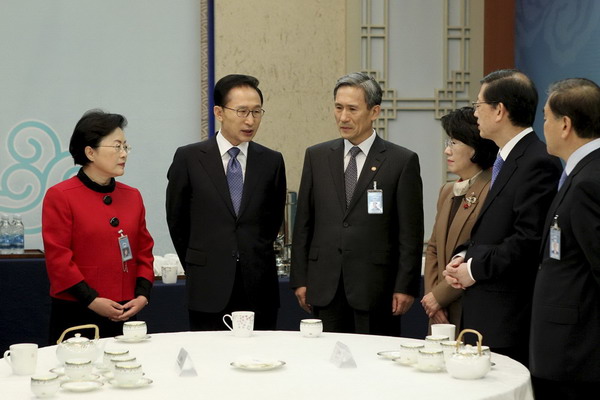 South Korea's President Lee Myung-bak (2nd L) talks with Defence Minister Kim Kwan-jin (3rd L) before a cabinet meeting at the presidential Blue House in Seoul Dec 21, 2010. [Photo/Agencies] |
| ||||


Still, South Korea's military said it was prepared for any unexpected DPRK provocation.
"We will mobilize reconnaissance and surveillance assets of South Korea and the US combined force and intensively monitor North Korea's military activities," Defense Minister Kim Kwan-jin told lawmakers before leaving for the security meeting.
Meanwhile, New Mexico Gov. Bill Richardson praised the DPRK's "statesmanlike" restraint as he wrapped up a four-day trip to the DPRK.
Richardson, a former US ambassador to the United Nations who has served as an unofficial envoy to the DPRK in the past, told Associated Press Television News in Pyongyang that his trip yielded "positive" results.
"It was a good visit _ positive results in our discussions with North Korea," he said Tuesday morning before boarding a plane in Pyongyang.
Richardson said the North agreed to let UN atomic inspectors visit its main nuclear complex to make sure the DPRK is not producing enriched uranium for a nuclear bomb, according to a statement from his office.
The United States, however, indicated skepticism that the DPRK would do anything more than talk.
"North Korea talks a great game. They always do," US State Department spokesman P.J. Crowley said in Washington. "The real issue is what will they do. If they are agreeable to returning IAEA (International Atomic Energy Agency) inspectors to their country, they need to tell the IAEA that."
The DPRK expelled UN inspectors last year, and last month showed a visiting American scientist a new, highly advanced uranium enrichment facility that could give it a second way to make atomic bombs, in addition to its plutonium program. Richardson also said that Pyongyang was willing to sell fresh fuel rods, potentially to the ROK.
"This is the way countries are supposed to act," Crowley told reporters. "The South Korean exercise was defensive in nature. The North Koreans were notified in advance. There was no basis for a belligerent response."
The DPRK's apparent conciliatory gestures came after the ROK launched fighter jets, evacuated hundreds of residents near its tense land border with the North and sent residents of islands near disputed waters into underground bunkers in case Pyongyang followed through on a vow to attack over the drills.
"We have to show North Korea that we are committed to respond to any kind of North Korean provocation," a senior ROK government official said Tuesday.
He said the lack of response Monday did not mean Pyongyang was backing down, noting that the DPRK thrives on "surprise" attacks and that ROK's military was braced for possible provocations in coming days. The official spoke on condition of anonymity, citing the sensitivity of the matter.
The DPRK has previously been accused of using a mix of aggression and conciliatory gestures to force international negotiations that usually net it much-needed aid. Real progress on efforts to rid the North of its nuclear weapons programs has been rare.
On Nov 23, the DPRK shelled Yeonpyeong Island, a tiny enclave of fishing communities and military bases about 7 miles (11 kilometers) from the DPRK's shores in response to an earlier round of ROK's live-fire maneuvers.
The artillery barrage killed two marines and two construction workers and was the first attack targeting civilian areas since the 1950-53 Korean War.
The Korean peninsula, still technically in a state of war, has remained tense for weeks, and UN diplomats holding an emergency meeting in New York on Sunday failed to find a solution to the crisis.
Pyongyang is believed to be seeking one-on-one talks with Washington before returning to stalled nuclear disarmament negotiations hosted by China. The US and the ROK, however, say resuming the talks without requiring meaningful movement on past nuclear commitments would reward the DPRK for bad behavior.
China has urged a resumption of the talks, and diplomats said Beijing successfully prevented Sunday's UN Security Council meeting from issuing a statement condemning the DPRK's shelling- as the US and others had wanted.
China's deputy UN ambassador Wang Min urged both sides "to exercise maximum restraint," avoid increasing tensions and solve differences through peaceful dialogue and engagement.
"China will continue to make every efforts towards this end," he said Monday. "Calm rather than tensions, dialogue rather than confrontation, peace than warfare- this is the strong aspiration and voice of the peoples from both sides of the peninsula and the international community."
Richardson appeared to suggest that his visit contributed to the North's backing down.
"During my meetings in Pyongyang, I repeatedly pressed North Korea not to retaliate. The result is that South Korea was able to flex its muscles, and North Korea reacted in a statesmanlike manner," Richardson said in a statement. "I hope this will signal a new chapter and a round of dialogue to lessen tension on the Korean peninsula."
The DPRK called Monday's drills a "reckless military provocation" but said they held fire because Seoul had changed its firing zones.
The official Korean Central News Agency carried a military statement that suggested the DPRK viewed Monday's drills differently from those that provoked it last month because the South's shells landed farther south of the North's shores.
The DPRK claims the waters around Yeonpyeong as its territory. Several bloody naval skirmishes have occurred in recent years along the Koreas' disputed western sea border, which the DPRK does not recognize.