Asia-Pacific
Indonesia volcano burns whole villages; 122 dead
(Agencies)
Updated: 2010-11-06 07:39
 |
Large Medium Small |
|
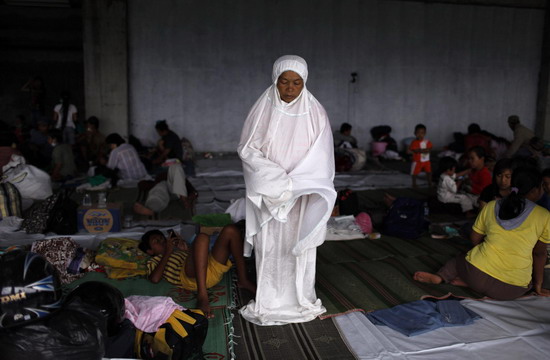 A woman prays in a temporary shelter at Maguwoharjo Stadium in Yogyakarta, November 5, 2010. [Agencies] |
Despite being at the foot of Indonesia's deadliest volcano, Yogyakarta has only one burn unit, at Sardjito. The facility is limited to 10 beds, though, and so turns away any patient without facial burns or whose body is burned less than 40 percent, according to Sigit Priohutomo, a senior official at Sardjito.


More than 100,000 people living on the mountain have been evacuated to crowded emergency shelters, many by force, in the last week. Some return to their villages during lulls in activity, however, to tend to their livestock.
They were told to stay away Friday. The government also announced an $11 million program to buy the cows on the mountain to keep farmers off its slopes, and to provide compensation for animals lost in the eruptions.
Indonesia, a vast archipelago of 235 million people, is prone to earthquakes and volcanoes because it sits along the Pacific "Ring of Fire," a horseshoe-shaped string of faults that lines the Pacific Ocean.
While Friday's explosion was the largest in volume in a century, an eruption at Merapi in 1930 killed many more, 1,300.
Even that toll pales in comparison to other volcanoes in the region: Indonesia's Krakatoa killed at least 36,000 people in 1883, in an eruption that could be heard 2,000 miles (3,200 kilometers) away and blackened skies region-wide for months.
When the Philippines' Mount Pinatubo exploded in 1991 after a 500-year slumber, about 800 people died as the billions of tons of volcanic debris poured from the cone, erasing entire farm communities and altering the world's climate.
The May 1980 eruption of Mount St. Helens caused the volcano's north flank to collapse, triggering the largest landslide ever recorded. The blast killed 57 people, flattened 230 square miles (596 square kilometers) of forests and blew 1,300 feet (400 meters) off the peak.