APEC economic leaders meet on Doha round, climate change
Updated: 2007-09-08 15:56
SYDNEY -- Leaders of the 21 member economies of the Asia-Pacific Economic Cooperation (APEC) began their annual informal meeting Saturday to discuss a range of issues including trade promotion and clean development.
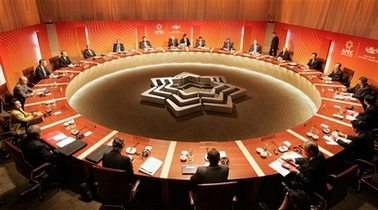 Leaders attend APEC economic leaders meeting in Sydney, Saturday, Sept. 8, 2007. [AP] |
The closed-door meeting was opened Saturday afternoon at Sydney 's iconic Opera House amid tight security.
In his opening address, Australian Prime Minister John Howard, who plays host to the leaders, said the meeting is "an opportunity for us to discuss the climate change issues."
"We also have the opportunity of talking about the Doha round (of the World Trade Organization negotiations)," he said.
Howard said he hopes the meeting will turn out one of the most productive in the history of APEC.
After the two-day gathering, the leaders are expected to adopt a stand-alone statement on the Doha Round to show their support for the multilateral trading system and determination to bring the negotiations to an early conclusion.
A Sydney declaration on climate change, energy security and clean development is also expected to be signed, probably after Saturday's retreat at the earliest.
The annual meeting of Pacific-rim leaders is a forum of the highest level in the Asia-Pacific region, drawing the presence of such prominent figures as Chinese President Hu Jintao, U.S. President George W. Bush, Russian President Vladimir Putin and Japanese Prime Minister Shinzo Abe.
Before starting their retreat, the leaders posed for an annual family photo in front of the heritage-listed Opera House, dressed in knee-length Driza-Bone coats, consumes of Australian flavor.
Founded in 1989, APEC is the premier forum for facilitating economic growth, cooperation, trade and investment in the Asia- Pacific region.
It represents the most economically dynamic region in the world, with its 21 member economies spanning four continents and accounting for approximately 40 percent of the world's population, 56 percent of world GDP and 48 percent of world trade.
The 21 member economies are Australia, Brunei, Canada, Chile, China, China's Hong Kong, Chinese Taipei, Indonesia, Japan, South Korea, Malaysia, Mexico, New Zealand, Papua New Guinea, Peru the Philippines, Russia, Singapore, Thailand, the United States and Vietnam.
|
|
|
||
|
||

|
|
|
|