Car bombs kill 50 fans after Iraq soccer win
(Agencies)Updated: 2007-07-26 09:02
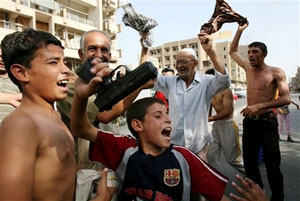 An Iraqi boy waves a toy pistol in central Baghdad, Iraq, Wednesday, July 25, 2007, after the country's national soccer team beat South Korea in the Asian Cup to reach the tournament's final. [AP]  |
Two suicide bombings killed at least 50 cheering, dancing, flag-waving Iraqis celebrating their national triumph. More than 130 other revelers were wounded.
The attacks bore the hallmarks of Sunni militants who have fueled the violence tearing at the fragile fabric of Iraq for nearly four years. But these bombings, in parked cars less than an hour apart in separate corners of Baghdad, appeared designed to gain attention rather than target a particular sect.
An ice cream parlor was the backdrop for the first attack, at about 6:30 pm. A suicide attacker exploded his car in a crowd of people cheering near the al-Riwad shop in the predominantly Sunni Mansour neighborhood in west Baghdad, according to the Interior Ministry. At least 30 people were killed and 75 wounded, the ministry said.
The second suicide car bombing took place in the midst of dozens of vehicles filled with revelers near an Iraqi army checkpoint in the eastern district of Ghadeer, where an uneasy mix of Sunnis, Shiites and Christians live. At least 20 people died and nearly 60 were wounded, the ministry said.
The barbarity of Wednesday's bombings will be remembered for what they abruptly ended.
Qusai Bilal, a 35-year-old Sunni grocer in Ghadeer, was watching the unusual sight of a street party outside his store. Young people danced and waved flags when tragedy struck.
"A huge blast occurred and, in a second, converted the glorious scene to a black one," he said.
Ahmed Sattar, who makes a living selling kebabs on a sidewalk grill in the district, asked what could motivate the attacker.
"I can't imagine what I had seen," said the 28-year-old Shiite. "The terrorist changed the happiness to sorrow, sadness. The place of joy was converted to a massacre in a matter of seconds. I'm wondering why."
University student Ahmad Mudhar, a Shiite, and his 7-year-old brother were celebrating in Mansour, waving the Iraq flag and singing along with hundreds of other revelers. After the bomber struck, the brothers walked home shaken and heartbroken.
"Even during the moments of happiness, the powers of evil and terrorism cause tragedy," Mudhar said. Iraqis, he predicted, would return to the streets in celebration "to shame the terrorists" if Iraq wins the cup.
The revelers were celebrating Iraq's semifinal win over South Korea in the Malaysian capital of Kuala Lumpur on Wednesday. Iraq won a tense penalty shootout 4-3 after the two sides played to a scoreless draw in 90 minutes regulation and 30 minutes extra time.
Iraq will now play Saudi Arabia on Sunday in Jakarta, Indonesia for the championship.
The casualties from the two suicide attacks were not the day's only soccer tragedies.
Celebratory gunfire that filled the Baghdad sky with bullets within seconds of the victory killed at least three people and wounded 19, according to initial police reports.
State Iraqiya television, perhaps eager not to diminish Iraqi joy, withheld the news of any deaths for at least four hours.
Five people had also been killed in the gunfire celebration after Sunday's quarterfinal win over Vietnam and the surprise 3-1 triumph over Australia in the group stages.
After Wednesday's victory, thousands danced, beat drums and sang. Traffic was snarled in much of the capital as cars, Iraqi flags flying from their windows, moved slowly through choking crowds of fans on foot. Motorists honked their horns and young people sprayed water on each other.
Police and soldiers joined in the celebrations, firing their assault rifles in the air, ignoring an appeal against gunfire from the military chiefs.
The successful run in the Asian Cup led many here to see the mixed sectarian team as proof the country could unite despite years of sectarian violence.
Politicians wasted no time in trying for propaganda gain, heaping praise on "The Lions of the Two Rivers" as a symbol of the Iraqi unity, ignoring their own failure to bridge the sectarian divide in Iraq that many see as a result of narrow political agendas.
Nouri al-Maliki, the embattled Shiite prime minister, led all others.
After the quarterfinal win over Vietnam, he appeared on television and spoke to the team: "Today you flew high the Iraqi flag. You created happiness with the participation of all Iraqis." He dispatched a close adviser to represent him in Wednesday's semifinal clash in Kuala Lumpur.
Spokesman Ali al-Dabbagh told state television the prime minister was trying to speak to the players individually to congratulate them.
"Our eyes were filled with tears by the victory," said al-Dabbagh.
President Jalal Talabani, a Kurd, proudly announced that he was the first to congratulate the team on its victory. A statement issued by his office said the team's victory "was a source of pride for Iraqis of all sects."
|
|
|
||
|
||
|
|