Top News
7 new wonders of the world chosen
(AP)
Updated: 2007-07-08 08:38
 |
Large Medium Small |
LISBON, Portugal - The Great Wall of China, Rome's Colosseum, India's Taj Mahal and three architectural marvels from Latin America were among the new seven wonders of the world chosen in a global poll released on Saturday.
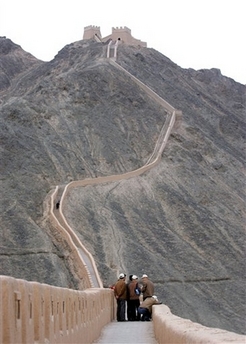 Chinese tourists walk on a rebuilt section of the Great Wall of China, near its western-most point, at Jiayuguan, in China's northwest Gansu province in this Oct. 11, 2005, file photo. [AP]  |
Jordan's Petra was the seventh winner. Peru's Machu Picchu, Brazil's Statue of Christ Redeemer and Mexico's Chichen Itza pyramid also made the cut.
About 100 million votes were cast by the Internet and cellphone text messages, said New7Wonders, the nonprofit organization that conducted the poll.
The seven beat out 14 other nominated landmarks, including the Eiffel Tower, Easter Island in the Pacific, the Statue of Liberty, the Acropolis, Russia's Kremlin and Australia's Sydney Opera House.
The pyramids of Giza, the only surviving structures from the original seven wonders of the ancient world, were assured of retaining their status in addition to the new seven after indignant Egyptian officials said it was a disgrace they had to compete.
The campaign to name new wonders was launched in 1999 by the Swiss adventurer Bernard Weber. Almost 200 nominations came in, and the list was narrowed to the 21 most-voted by the start of 2006. Organizers admit there was no foolproof way to prevent people from voting more than once for their favorite.
A Peruvian in national costume held up Macchu Picchu's award to the sky and bowed to the crowd with his hands clasped, eliciting one of the biggest cheers from the audience of 50,000 people at a soccer stadium in Portugal's capital, Lisbon.
Many jeered when the Statue of Liberty was announced as one of the candidates. Portugal was widely opposed to the US-led invasion of Iraq.
Another Swiss adventurer, Bertrand Piccard, pilot of the first hot-air balloon to fly nonstop around the world, announced one of the winners - then launched into an appeal for people to combat climate change and stand up for human rights before being ushered off the stage.
The Colosseum, the Great Wall, Machu Picchu, the Taj Mahal and Petra had been among the leading candidates since January, while the Statue of Christ Redeemer received a surge in votes more recently.
The Statue of Liberty and Australia's Sydney Opera House were near the bottom of the list from the start.
Also among the losing candidates were Cambodia's Angkor, Spain's Alhambra, Turkey's Hagia Sophia, Japan's Kiyomizu Temple, Russia's Kremlin and St. Basil's Cathedral, Germany's Neuschwanstein Castle, Britain's Stonehenge and Mali's Timbuktu.
Weber's Switzerland-based foundation aims to promote cultural diversity by supporting, preserving and restoring monuments. It relies on private donations and revenue from selling broadcasting rights.
The UN Educational, Scientific and Cultural Organization, or UNESCO, keeps a list of World Heritage Sites, which now totals 851 monuments. But the agency was not involved in Weber's project.
The traditional seven wonders were concentrated in the Mediterranean and Middle East. That list was derived from lists of marvels compiled by ancient Greek observers, the best known being Antipater of Sidon, a writer in the 2nd century B.C.
The Hanging Gardens of Babylon, the Statue of Zeus at Olympia, the Temple of Artemis at Ephesus, the Mausoleum of Halicarnassus, the Colossus of Rhodes and the Pharos lighthouse off Alexandria have all vanished.
| 分享按钮 |