US General B.B. Bell, commander of US
Forces in Korea, speaks during a forum with journalists at the National
Press Club in Seoul July 2, 2007. North Korea's recent tests of
short-range missiles were successful launches of an advanced weapon that
can be fired at little notice to strike targets in South Korea, Bell said.
[Reuters]
 |
SEOUL
- North Korea's recent tests of short-range missiles were successful launches of
an advanced weapon that can be fired at little notice to strike targets in South
Korea, the commander of US Forces in South Korea said on Monday.
North Korea tested at least three short-range missiles over the past month,
with the latest test last week coming as UN nuclear inspectors were in the
country as a part of a disarmament deal.
"These (missiles) are modern, solid-fuel, which means that they are easy to
handle and rapidly capable of being fired," US General B.B. Bell said at a
seminar in Seoul.
"These were not failure missile tests. These were successful tests."
The White House said last week it was "deeply troubled" by North Korea's
recent test-firing of short-range missiles, but officials in Seoul and at the
Pentagon in Washington downplayed them as routine and not provocative.
"What I find very disturbing is that the North continues to test these
advanced short-range missiles," Bell said.
North Korea, which tested its first nuclear weapon last year, has more than
1,000 missiles of various ranges, including 800 ballistic missiles, capable of
hitting all of South Korea and almost all of Japan, proliferation experts have
said.
"One of the biggest threats to peace and stability is the potential
capability of North Korea to couple its missile technology with its demonstrated
nuclear ability," Bell said.
Proliferation experts say it is unlikely that North Korea has developed the
technology to miniaturize nuclear weapons that would allow them to be mounted on
a missile.
North Korea defied international warnings and test-fired a barrage of seven
ballistic missiles about a year ago, including its long-range Taepodong-2
missile.
Bell said one of the greatest threats South Korea faces is from the massive
amount of artillery the North has placed near the border with the South, which
includes 250 long-range systems capable of hitting Seoul, only 50 km (30 miles)
from the border.
"This is a very real threat which cannot be ignored," Bell said.
He hoped North Korea would live up to pledges it made in a February 13
nuclear deal among the two Koreas, China, Japan, Russia and the United States
that called for Pyongyang to start shutting its reactor at Yongbyon, a source of
weapons-grade plutonium.
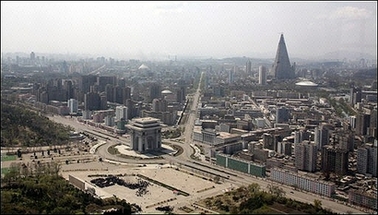
 A view of Pyongyang, including the Arc of Triumph(L) and the
"Pyramid," an uncompleted hotel, in North Korea, April 2007.
[Agencies]

 |