Car bomb kills anti-Syrian MP, 9 others in Beirut
(Reuters)Updated: 2007-06-14 09:11
BEIRUT - A powerful car bomb killed anti-Syrian Lebanese lawmaker Walid Eido and nine other people on Wednesday in an attack his allies blamed on Damascus.
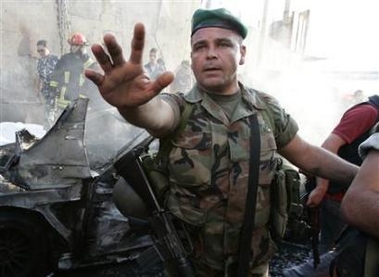 A soldier secures the area next to a burnt car after an explosion in Beirut, June 13, 2007. [Reuters]  |
One of the parliamentarian's sons and two bodyguards were among the dead. At least 11 people were wounded.
Eido, 64, belonged to the majority anti-Syrian parliamentary bloc of Saad al-Hariri, which controls the government.
A Sunni Muslim lawyer, he had been a foe of Syrian influence in Lebanon and an ally of former Prime Minister Rafik al-Hariri, who was assassinated by a suicide truck bomber in February 2005.
Eido was killed just three days after a UN Security Council resolution came into effect setting up an international tribunal to try suspects in Hariri's assassination.
"This crime is a clear message from the Syrian regime to Lebanon in response to the establishment of the international tribunal," Saad al-Hariri's coalition said in a statement.
Hariri says Syria was behind his father's killing and later attacks. Damascus denies involvement. Including Eido, seven anti-Syrian figures have been slain in Lebanon since 2005.
"It is the same fingers that assassinated the martyred premier Rafik al-Hariri," Hariri said of Eido's killing.
There was no immediate comment from Syria. Its allies in Lebanon denounced the assassination.
"Big, ugly cloud"
The blast, near a seafront amusement park and a football club, destroyed several cars and shattered windows of nearby buildings. It hurled the bodies of Eido and his son over a wall and into the football ground, witnesses said.
Two players in the Nejmeh football team, which is in Lebanon's top league, were among those killed.
"It sounded like it was in your backyard," said Herbert Lahout, 45, a US citizen who had been playing volleyball on a nearby beach. "It was like a mushroom cloud, a big ugly cloud."
Five less powerful bombs have exploded in and around Beirut in the past month, killing two people.
Eido's death was likely to fuel tension between the government and the pro-Syrian opposition led by the Shi'ite Muslim Hezbollah group, which has condemned the killing.
Condemnation also came from the United States, France, Britain, the European Union and the United Nations.
"There has been a clear pattern of assassinations and attempted assassinations in Lebanon since October 2004," US President George W. Bush said. "Those working for a sovereign and democratic Lebanon have always been the ones targeted."
"The United States will continue to stand up for Lebanon, its people, and its legitimate government as they face these attacks," he added.
The Beirut government declared Thursday, when the funerals were due to take place, a day of national mourning.
"Lebanon and the Lebanese will not submit to terrorism," Siniora said after an emergency cabinet session.
He said the government was asking the UN commission investigating Hariri's assassination to help with the inquiry into Eido's killing and add it to the tribunal's work.
UN Secretary-General Ban Ki-moon urged the Lebanese government to bring the perpetrators to justice.
"When Lebanon's people are going through a democratization process, this kind of heinous terrorist attack to assassinate political opponents is just unacceptable," he added.
The UN Security Council, in a policy statement initiated by France, condemned "any attempt to destabilize Lebanon through political assassination or other terrorist acts."
Tension was already high in Lebanon, where the army has been battling al Qaeda-inspired Islamist militants at a Palestinian refugee camp in the north for more than three weeks.
Hariri's bloc linked Eido's assassination to the clashes with Fatah al-Islam, saying these were "two sides of same coin which is the terrorism of the Syrian regime."
Damascus denies any links with Fatah al-Islam.
|
||
|
||
|
|