Europe
Bush, Merkel far apart on climate change
(AP)
Updated: 2007-06-06 16:54
 |
Large Medium Small |
ROSTOCK, Germany - Both US President Bush and German Chancellor Angela Merkel have been making optimistic comments about the prospects for agreement on climate change.
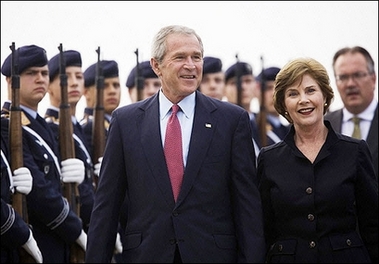 US President George W. Bush and First Lady Laura Bush walk past an honour guard upon arrival at Rostock-Laage Airport in Rostock, Germany. German Chancellor Angela Merkel will urge G8 leaders to take a bold step forward on climate change at a summit starting Wednesday but the event could be upended by US-Russian tensions. [AFP]  |
"There's a lot more in common, in a way, than there is in disagreement," said Bush's national security adviser, Stephen Hadley.
The US has now acknowledged that global warming is a serious problem that must be addressed, and that doing so requires a global goal. Europe and others have come around to Washington's view that no solution is viable without the participation of developing energy guzzlers such as China, India and Brazil, and that economic growth can't be sacrificed for progress on climate.
What Hadley did not mention is the chasm that still exists on how to meet these principles.
Germany, as summit host, is pushing specific targets for reduction of the carbon emissions believed to cause global warming. Merkel has made the issue the centerpiece of her G-8 leadership.
Her proposal is for a "two-degree" target, under which global temperatures would be allowed to increase no more than 3.6 degrees Fahrenheit, (2 degrees Celsius) before being brought back down. Practically, experts have said that means a global reduction in emissions of 50 percent below 1990 levels by 2050. Merkel supports a global carbon-trading market as one tool.
But Bush remains opposed to hard targets, preferring voluntary goals to be met primarily by technological advances. Last week, he announced his idea for how to move forward: a global emissions goal negotiated by the world's 15 largest polluters, including the big emerging economies, by the end of next year.
The catch? Each nation would decide for itself how to meet the goal and whether to make the targets binding.
Some criticized Bush for announcing his proposal in a speech just days before the summit, instead of quietly bringing it with him. They said Bush undermined Merkel with something that amounted to little more than kicking the problem down the road for an uncertain result.
Not so, said Hadley.
"This is an effort by the president to be constructive and to make a contribution to the dialogue," he said. "Quite frankly, it's an opportunity for Angela Merkel to preside over a very successful G-8."
Merkel has called the proposal a decent place to start finding common ground. And Bush has assured her he is committed to using the United Nations as the forum to reach a new global warming pact to succeed the Kyoto Protocol, which expires in 2021 — a key demand by the chancellor.
Julianne Smith, director of the Europe Program at the Center for Strategic and International Studies in Washington, predicted the summit would produce nice talk on the nature of the problem but "more disagreement on the means."
Charles Kupchan, director of Europe studies for the Council on Foreign Relations, called Bush's pre-summit climate announcement "more of a palliative to the Europeans rather than a serious step forward."
"It's very difficult for me to believe that Bush, when he comes to the end of his administration, is going to sign off on some deal that he wasn't willing to sign off on before," he said.
A report in May from a U.N. network of more than 2,000 scientists estimates the world must stabilize the amount of greenhouse gases in the atmosphere within eight years to keep global temperatures from spiking to disastrous levels.
Bush also was meeting Wednesday with Japanese Prime Minister Shinzo Abe.
Protesters are being held at bay from Heiligendamm, the Baltic Sea resort town hosting the gathering, by an eight-foot-high, razor-wire-topped fence. Despite that deterrent, the area was rocked over the weekend by violent demonstrations dubbed Germany's worst in decades.
There could be fireworks among the leaders, too.
The days leading up to the meetings were dominated by jarring rhetoric from Russian President Vladimir Putin over US plans to base a new missile defense system in nearby Czech Republic and Poland.
Merkel has fretted about the dispute's effect on US-Russia relations and beyond, and pleaded with Bush to engage aggressively with Putin. But the chancellor had her own frosty meeting with the Russian leader, during which she criticized his crackdown on political opponents.
This sort of firm line earned praise from Bush, due for a private sit-down Thursday with Putin on the summit's sidelines. "She's proven herself to be a very strong leader," he told foreign reporters.
| 分享按钮 |