Africa
Bush to announce new sanctions for Sudan
(AP)
Updated: 2007-05-29 15:29
 |
Large Medium Small |
WASHINGTON - US President Bush hopes new US economic sanctions will force the hardline Sudanese government to quit blocking international efforts to end the bloodshed in Darfur.
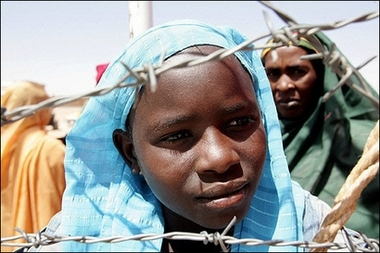 A refugee waits behind barbed wire for a medical examination at the Turkish Red Crescent Hospital in the Darfur city of Nyala, February 2007. [AFP]  |
Beyond the US sanctions Bush was to announce Tuesday at the White House, the president also will direct Secretary of State Condoleezza Rice to draft a proposed UN resolution to strengthen international pressure on the Sudanese government of President Omar al-Bashir, according to two administration officials who briefed reporters Monday night.
Bush says al-Bashir's actions over the past few weeks "follow a long pattern of promising cooperation while finding new methods of obstruction," according to a draft of the remarks.
The sanctions will prohibit more companies in Sudan from using the US financial system, stiffen enforcement of existing sanctions and target individuals suspected of fomenting violence, according to the officials who spoke on condition of anonymity so as not to pre-empt the president's remarks.
The bloody conflict - which the Bush administration has labeled genocide - began when rebels from ethnic African tribes rose up against the Arab-led central government. The Sudanese government is accused of responding by unleashing the janjaweed militias of Arab nomads, blamed for indiscriminate killing. The government denies the charges.
Al-Bashir agreed in November to a three-phase UN plan to strengthen the overstretched, 7,000-strong African Union force in Darfur.
After five months of stalling, the Sudanese president gave the go-ahead in April for the second phase - a "heavy support package" with 3,000 UN troops, police and civilian personnel along with six attack helicopters and other equipment.
Over the weekend, however, al-Bashir reiterated his opposition to the deployment of a 22,000-strong joint UN-AU force, saying he would only allow a larger African force with technical and logistical support from the United Nations.
Bush said the Sudanese government must stop opposing the joint UN-AU force, quit supporting violent militias and let humanitarian aid reach the people of Darfur.
The new sanctions target 31 companies to be barred from the US banking system. Thirty of the companies are controlled by the government of Sudan; the other one is suspected of shipping arms to Darfur, the officials said.
Nearly 10 years ago, the United States cut off about 130 Sudanese companies from the US system over a different dispute, forcing them to find ways to do business outside the sanctions framework.
The US also is targeting three individuals, cutting them off from the US financial system to prevent them, too, from doing business with US companies or individuals. Two of the Sudanese individuals have alleged links to the janjaweed militias. The third is a senior rebel leader suspected of contributing to bloodshed and human rights violations in Darfur.
The UN resolution Bush is seeking would apply new international sanctions against the Sudanese government in Khartoum. It also would seek to impose an expanded embargo on arms sales to Sudan, prohibit Sudan's government from conducting offensive military flights over Darfur and strengthen the US ability to monitor and report any violations.
| 分享按钮 |