Middle East
US frees 42 Iraqi captives in raid
(AP)
Updated: 2007-05-28 08:34
 |
Large Medium Small |
BAGHDAD - American forces freed 42 kidnapped Iraqis - some of whom had been hung from ceilings and tortured for months - in a raid Sunday on an al-Qaida hideout north of Baghdad, the US military said.
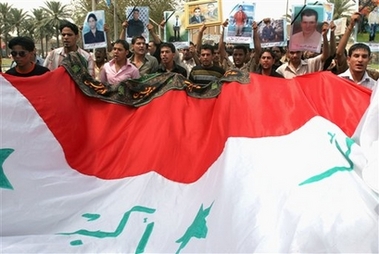 Students of Mustansiriyah university protest behind an Iraqi flag as they hold pictures of colleagues killed last week by gunmen in Waziriya neighborhood in northern Baghdad, Sunday, May 27, 2007. [AP]  |
"The people in Diyala are speaking up against al-Qaida," said Maj. Gen. William Caldwell, the top US military spokesman in Iraq.
Elsewhere in Diyala, a US soldier was killed when an explosion hit his vehicle and a second soldier was killed in an explosion in Baghdad, the military said. The deaths brought the number of troops killed this month to at least 102, putting May on pace to become the deadliest month for Americans here in more than 2 1/2 years.
In other violence, a barrage of mortar rounds struck houses in a Shiite village just northeast of Baghdad, killing three women and a child and wounding seven other children, Baghdad police said.
A suicide car bomber attacked an army checkpoint in Musayyib, about 40 miles south of Baghdad, killing two Iraqi soldiers.
Gunmen also killed the renowned Baghdad calligrapher Khalil Mohammed al-Zahawi in a drive-by shooting in a Shiite dominated area in eastern Baghdad, police said. Al-Zahawi, 52, who was also a lecturer at Baghdad University, was waiting for a taxi on a main road when the gunmen sped past.
US military officials have said they expected insurgents to step up attacks as US-led forces worked to crack down on violence in Baghdad and the surrounding areas during their 14-week-old security operation.
As part of the crackdown, the military sent 3,000 more US troops to Diyala, a turbulent province north of Baghdad that has seen heavy fighting in recent weeks. Sunday's raid, the military said, was a sign that the increase was working.
"The more contact we have (with) the Iraqi citizens, the more confidence that they develop in us, and in the Iraqi police and the Iraqi army. That leads to greater cooperation from the Iraqi citizenry," said Lt. Col. Christopher Garver, a US military spokesman.
Some of the men suffered broken bones. Some had been captive for as long as four months. One said he was just 14 years old, Caldwell said.
The 42 freed Iraqis marked the largest number of captives ever found in a single al-Qaida prison, he said.
Meanwhile, in Kut, 100 miles southeast of Baghdad, 70 police officers resigned from an elite police unit and handed over their weapons, saying they were afraid of the Mahdi Army militia of the radical Shiite cleric Muqtada al-Sadr, police said.
Earlier this week, Mahdi Army militants captured at least seven members of the police's rapid deployment force during a gunbattle, police said. The militants badly beat the police and warned them to stop their offensive against the militia or they would kill them, an officer said on condition of anonymity because he feared retaliation.
Some officers had their houses firebombed, their children kidnapped and their relatives killed, he said.
"I fear reprisals, I want to keep my family and relatives safe," he said.
Another officer who resigned said the Mahdi Army threw a grenade at a colleague's house, killing his mother and wounding his brother.
"We don't have sufficient weapons, just a rifle," he said, refusing to give his name as well.
On Monday, Iranian and US diplomats were scheduled to hold rare talks in Baghdad over how to end the violence here. US officials accuse Shiite-ruled Iran of training, financing and arming militants - including the Mahdi Army - to fan sectarian tensions. Iran denies the charge and blames the presence of US forces here for the violence.
US and Iraqi troops raided Baghdad's Sadr City slum Sunday morning, arresting a suspect believed involved in smuggling armor piercing bombs from Iran, the military said. The suspect was part of a cell that also sent Iraqi militants to Iran for training, the statement said.
In the southern city of Basra, British forces on a raid to arrest Shiite militants came under fire and killed three of their attackers, the British military said. No British forces were injured, it said.
Al-Sadr, who emerged from months in hiding last week, met Sunday with leaders of his movement in an apparent effort to restore discipline to the group, which had shown signs of splintering in his absence. He repeated his demands for a quick US troop withdrawal, Salah al-Obeidi, a senior aide to al-Sadr, told reporters.
"The occupation forces bear responsibility for the suffering the country is facing and there is no solution but the withdrawal of the forces," he said.
| 分享按钮 |