Middle East
9 US warships enter Gulf for training
(Reuters)
Updated: 2007-05-23 15:07
 |
Large Medium Small |
ABOARD USS JOHN C. STENNIS - Nine US military ships entered the Gulf on Wednesday for a rare daylight assembly off Iran's coast in what naval officials said was the largest such move since the 2003 Iraq war.
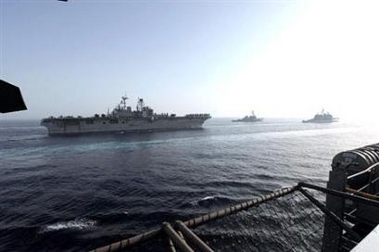 Nimitz-class aircraft carrier USS John C. Stennis (CVN 74), nuclear-powered aircraft carrier USS Nimitz (CVN 69), and amphibious assault ship USS Bonhomme Richard (LHD 6) transit the Gulf of Oman in a US Navy photo released on May 22, 2007.[Reuters]  |
Most US ships pass through the straits at night so as not to attract attention, and rarely move in such large numbers.
Navy officials said the decision to send a second aircraft carrier was made at the last minute, without giving a reason.
Tension between the United States and Iran over Tehran's nuclear ambitions and Iraq has raised regional fears of a possible military confrontation that could hit Gulf economies and threaten vital oil exports.
But Rear Admiral Kevin Quinn, leading the group, said the ships would start conducting exercises after passing through the straits as part of a long-planned effort to reassure nearby countries of US commitment to regional security.
"There's always the threat of any state or non state actor that might decide to close one of the international straits, and the biggest one is the Straits of Hormuz," he told reporters on the USS John C. Stennis aircraft carrier before the crossing.
POWERFUL
On the way to the straits, a public announcement called on crew to witness "some of the most powerful ships in the world," whose tight formation against a backdrop of the setting sun created a dramatic image of American naval might.
The group of ships, carrying around 17,000 personnel, crossed at roughly 0355 GMT.
The maneuvers come less than two weeks after US Vice President Dick Cheney, speaking aboard the Stennis during a tour of the Gulf, said the United States would stand with others to prevent Iran gaining nuclear weapons and "dominating the region."
On a visit to Abu Dhabi a few days later, Iranian President Mahmoud Ahmadinejad threatened "severe" retaliation if the United States attacked his country, which is locked in a standoff with the United States over its nuclear programme.
He also urged Gulf countries to "get rid of" foreign forces, blaming them for insecurity in the region.
The United States accuses Iran of trying to produce nuclear weapons, and has sought tougher UN sanctions against Iran. Iran says its nuclear ambitions are for energy purposes only.
US and Iranian ambassadors are due to meet on Monday in Baghdad to discuss security in Iraq, where the United States has accused Iran of fomenting violence by backing Shi'ite militia there, and of providing weapons and the technology for roadside bombs. Iran has denied the accusations.
Last month, the US Fifth Fleet base in Bahrain conducted its biggest crisis response drill and in March, the US navy conducted its biggest war drills in the Gulf since 2003.
| 分享按钮 |