Americas
Bush declassifies al-Qaida intelligence
(AP)
Updated: 2007-05-23 08:35
 |
Large Medium Small |
WASHINGTON - President Bush, trying to defend his war strategy, declassified intelligence Tuesday asserting that Osama bin Laden ordered a top lieutenant in early 2005 to form a terrorist cell that would conduct attacks outside Iraq - and that the United States should be the top target.
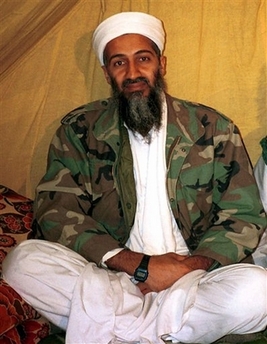 This is an undated photo Osama bin Laden in Afghanistan. President Bush declassified intelligence Tuesday, May 22, 2007 asserting that bin Laden ordered a top lieutenant in early 2005 to form a terrorist cell that would conduct attacks outside Iraq - and that the United States should be the top target. [AP]  |
The declassification of the intelligence came a day before Bush was scheduled to speak about terrorism at the US Coast Guard Academy.
Bush, who is battling Democrats in Congress over spending for the unpopular war in Iraq, will argue that the terrorist threat to America is real, said Frances Fragos Townsend, the White House homeland security adviser. She said Bush would talk about why Iraq is an important battleground in fighting terrorism abroad to prevent attacks on US soil and highlight previously reported successes in foiling terrorist attacks.
The Bush White House has intermittently declassified and made public sensitive intelligence information to help rebut critics or defend programs or actions against possibly adverse decisions in the Congress or the courts. On a few occasions, the declassified materials were intended as proof that terrorists see Iraq as a critical staging ground for global operations.
Democrats and other critics have accused Bush of selectively declassifying intelligence, including portions of a sensitive National Intelligence Estimate on Iraq, to justify the US-led invasion on the ground that Saddam Hussein's regime possessed weapons of mass destruction. That assertion proved false.
Townsend, reading from notes, said the declassified intelligence showed that in January 2005, bin Laden tasked al-Zarqawi with organizing the cell. Al-Zarqawi, the former leader of al-Qaida's Iraq operations, was killed there in June 2006 by a US airstrike.
"We know from the intelligence community that al-Zarqawi welcomed the tasking and claimed he already had some good proposals," Townsend said.
She said that in the spring of 2005, bin Laden instructed Hamza Rabia, a senior operative, to brief al-Zarqawi on al-Qaida planning to attack sites outside Iraq, including the United States. She did not disclose where in the United States those attacks were being plotted.
Around the same time, Abu Fajah al-Libi, a senior al-Qaida manager, suggested that bin Laden send Rabia to Iraq to actually help al-Zarqawi plan the external operations, Townsend said. It is unclear whether Rabia went to Iraq, she said.
She said the information was declassified because the intelligence community has tracked all leads from the information.
| 分享按钮 |