Middle East
Iranian leader works to end US-Gulf ties
(AP)
Updated: 2007-05-15 08:54
 |
Large Medium Small |
ABU DHABI, United Arab Emirates - Iran's hard-line president stepped up efforts Monday to pry Gulf countries from their strong US alliance, urging them to push out the American military from bases in the region.
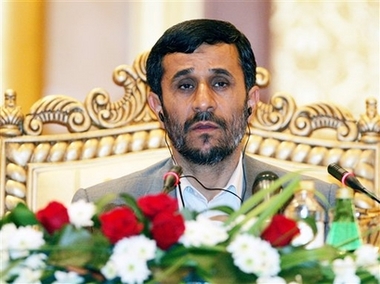 Iran's President Mahmoud Ahmadinejad talks to journalists at the Emirates Palace in Abu Dhabi, United Arab Emirates, Monday, May 14, 2007. Ahmadinejad will leave UAE to Oman later in the day. [AP]  |
It also came as the United States and Iran agreed to talk in Baghdad about Iraq's deteriorating security. Although seen as a political turnabout, potential for real progress is low as tensions - and sharp words - continue to escalate.
In stark contrast to Cheney's low-key visit, Ahmadinejad was greeted at the airport Sunday with a red carpet and the top leaders of the Emirates. But no Emirati leaders joined Ahmadinejad at his public events, and there appeared to be an effort to give the Iranian leader a warm welcome but keep a distance from his statements.
In three separate addresses here, the fiery Iranian leader called for American troops to "pack their bags" and leave US bases in the Gulf. He also was defiant about his country's disputed nuclear program, days after Cheney's tough talk from the deck of US aircraft carrier in the Persian Gulf. The US accuses Iran of secretly trying to develop nuclear weapons - a claim that Iran denies.
"The superpowers cannot prevent us from owning this" nuclear technology, Ahmadinejad told reporters in the opulent Emirates Palace hotel. "If they want to strike us militarily, I say their use of these practices will be gone forever. The Iranian people can protect themselves and retaliate."
Despite two sets of sanctions, Iran has ignored UN Security Council demands that it suspend uranium enrichment, which can generate both energy and produce the fissile core of nuclear warheads.
On Sunday, inspectors for the International Atomic Energy Agency found Iran had overcome many of its technological problems in keeping its centrifuges running at the underground enrichment plant in Natanz, the New York Times reported.
Diplomats familiar with Iran's nuclear program have said the country recently set up more centrifuges at Natanz, bringing the number of machines ready to spin uranium gas into enriched form to more than 1,600. IAEA officials have said the country has started enriching small amounts of uranium.
Ahmadinejad, however, also appeared keen to show his country was willing to use its influence in the region, particularly in Iraq, where Iran is close to Shiite political parties.
"We decided we were ready and prepared to do this to support the Iraqi people," he said about the planned talks with the US on Iraq's security situation. He spoke at a news conference before departing for a two-day visit to neighboring Oman, another of Washington's Gulf allies, which allows the United States use of four air bases.
Ahmadinejad urged the US military to leave the Gulf, where it keeps 40,000 troops on bases and another 20,000 in Mideast waters.
"What are these outsiders doing in our region?" he said Monday when asked to comment on Cheney's remarks Friday aboard the USS John C. Stennis.
But it did not appear that Ahmadinejad's visit was any indication that the UAE was shifting its ties with America, which remain closer than Iran's. The Emirates' foreign minister left Monday for a visit to Washington. US Navy ships use three ports in the Emirates and the US Air Force operates from at least three airports, including flying U-2 and Global Hawk spy planes from al-Dhafra Air Base just outside Abu Dhabi.
An Emirates official made it clear the government did not endorse a raucous anti-American rally Sunday at a Dubai soccer stadium, where an audience of several thousand chanted "Down with America!" during Ahmadinejad's speech. The official, who spoke on condition of anonymity because he is not authorized to make government statements, said the rally was "purely an Iranian affair."
"Everyone here and throughout the Gulf knows who Ahmadinejad is and what he represents. He's an extremist," said Abdulkhaleq Abdulla, a political scientist at Emirates University. "People don't trust him. This guy isn't going to energize or mobilize people against America or Bush. People here have their own views of Bush."
The Emirates invited Ahmadinejad for the visit - the first by an Iranian leader since UAE independence in 1971 - to let him know the Gulf Arab state will remain neutral in his showdown with Washington, Abdulla said. But it must still toe a fine line between Ahmadinejad and the Bush administration.
"Dick Cheney came here with certain demands and people here didn't like it. He's not somebody who is well-liked here, but we have to welcome him because he still represents the United States," Abdulla said.
Ahmadinejad, meanwhile, also stressed that relations with the Emirates had taken a "quantum leap," and the two countries agreed to create a joint committee headed by their foreign ministers to boost cooperation in tourism, trade, energy and development.
"There's a willingness on both sides to upgrade relations," Ahmadinejad said. "Relations between Iran and the UAE can be a model for all the countries of the region." He also called for the reestablishment of diplomatic relations with Egypt that were broken in 1979.
The Iranian delegation has similar plans in Oman, a sparsely populated oil-producing state. Iran and Oman share the territory that forms the strategic Strait of Hormuz, through which two-fifths of the world's oil shipments pass.
Iran's state news agency, IRNA, reported Monday that Ahmadinejad hopes to establish government trade offices in Oman's capital of Muscat and the port city of Khasab, which sits near the strait, just across from Iran. Khasab is also the site of an airport that has been used as a base by the US military.
| 分享按钮 |